










Qubika announced the public launch of QBricks, a Built on Databricks Agent OS accelerator that streamlines the development, evaluation, governance, and deployment of intelligent agents at scale. Already in active use across numerous Qubika clients, QBricks serves as the operational control plane for the full lifecycle of AI agents, ensuring orchestration, observability, auditability, and compliance with standards including SOC 2, GDPR, and ISO 27001.
The Challenge: Why AI Initiatives Stall
One of the key 2026 priorities for enterprise leaders is ensuring scalable, governed AI that delivers measurable ROI and sustained business impact. However, building such production-level capabilities remains complex.
In practice, AI initiatives fail, or stall at the pilot stage, not because of deficiencies in the core models, but because enterprises hit a complexity ceiling once they scale beyond a handful of agents. Coordination breaks down, agents develop unexpected behaviors, and failures cascade across systems. The missing piece is not better models. It is the operating system around them.
Every AI project has two essential dimensions:
- The business dimension: focused on value creation and return
- The Agent OS dimension: the operational layer focused on governing autonomy, orchestrating coordination, ensuring observability, safeguarding data integrity, and enabling workforce transformation
It is within this Agent OS layer that capabilities such as autonomy calibration, guardrails, evaluation, observability, deployment, security, governance, and cost control ultimately determine whether AI systems can scale reliably and sustainably.
Launching QBricks: A Built on Databricks Solution
To address this challenge, Qubika is proud to announce the public launch of QBricks, a Built on Databricks solution designed to accelerate and manage the end-to-end lifecycle of enterprise AI agents.
QBricks is a comprehensive Agent OS accelerator that streamlines how organizations design, develop, evaluate, deploy, and govern intelligent agents at scale, moving them decisively from pilot to production.
Crucially, it closes the auditability gap that plagues most enterprise agent deployments, giving managers and leaders real-time visibility into how many agents are running, how much they cost, where they fail, and whether decisions carry the interpretable lineage that auditors and regulators demand.
Already in active use across multiple Qubika clients, QBricks provides a centralized, production-ready platform that emphasizes scalability, observability, and compliance from day one.
Architectural Principles and Key Benefits
QBricks is purpose-built for enterprise environments, combining flexibility with robust governance.
- Secure and compliant by design.QBricks runs natively on the Databricks Data Intelligence Platform, ensuring alignment with industry standards including SOC 2, GDPR, and ISO 27001.
- Enterprise-grade data privacy. All data remains encrypted, access-controlled, and fully contained within the customer’s own cloud or preferred infrastructure. This ensures data sovereignty, minimizes external dependencies, and reduces risk associated with third-party data movement.
- Seamless cloud and Databricks integration.QBricks integrates directly with Databricks and supports deployment across any enterprise cloud or infrastructure configuration.
- Reusable, standalone code with no vendor lock-in. Agents built with QBricks are fully portable. They function independently of Qubika and can be executed on any mainstream agent orchestrator, giving organizations complete ownership and long-term flexibility.
Four Layers That Form a Complete Agent OS
QBricks enables enterprises to scale AI safely and predictably by standardizing four critical layers of the AI stack.
Layer 1: Autonomy Management and Governance
Gives leaders the control plane for their agent ecosystem: what agents exist, how they perform, where they fail, and what they cost. It also calibrates the appropriate level of autonomy for each workflow: agents can reason and propose freely, but only take action after passing through the right control gate, whether human approval or automated evaluation. This transparency prevents AI initiatives from becoming opaque experiments that stall adoption.
Layer 2: Orchestration and Runtime
Ensures AI agents can be reliably coordinated and operated at scale, with controlled rollouts, versioning, rollbacks, and multi-environment deployments. As organizations scale from a few agents to ten, fifteen, or twenty in a single deployment, robust orchestration becomes the difference between compounding value and compounding failures.
Layer 3: Agent Design and Composition
Accelerates delivery by providing reusable patterns and building blocks that span both the cognitive layer (reasoning, exploring, proposing) and the actuation layer (writing to systems, triggering workflows, executing decisions). This reduces development time, improves consistency across teams, and lowers maintenance costs, so teams focus on business outcomes, not rebuilding agent infrastructure from scratch for every use case.
Layer 4: Evaluation, Observability, and Security
Ensures AI systems are measurable, auditable, and compliant from day one. Organizations can continuously track accuracy, performance, and cost; enforce access controls and guardrails; maintain interpretable decision lineage; and detect issues before they cascade across the agent ecosystem.
Together, these four layers form a complete Agent OS: the unified operational layer that governs autonomy, orchestrates coordination, ensures observability, and safeguards data integrity. QBricks turns this architecture from concept into production reality, converting isolated AI tools into trusted, enterprise-scale workflows that deliver sustained business value.
Built on Databricks for Scalable AI Innovation
QBricks is a certified “Built on Databricks” solution, leveraging the power of the Databricks Data Intelligence Platform, which enables more than 20,000 organizations worldwide to unlock value from their data for analytics, AI applications, and intelligent agents.
Architecturally, QBricks integrates with:
- Databricks Lakebase for unified data access
- Databricks Vector Search for low-latency semantic retrieval
- GraphFrames for graph-based reasoning and relationship modeling
This native data platform integration addresses one of the most persistent challenges in enterprise agent deployments: data readiness. Organizations routinely overestimate how accessible and clean their data is before agents go into production. By connecting agents directly to governed, enterprise-quality data through Databricks, rather than through bolted-on pipelines, QBricks eliminates the gap between expected and actual data readiness.
This architecture enables seamless integration with enterprise data sources, large language models (LLMs), and downstream systems while preserving a single operational control plane.
For organizations not using Databricks, QBricks can also be deployed in the cloud of choice (AWS, Azure, GCP) or using a hosted environment from Qubika. It is built on LangGraph, the market leader in agent frameworks and the gold standard for building structured, reliable agent systems.
Core Capabilities Built for Production
QBricks delivers a powerful, production-ready ecosystem of tools and capabilities:
- Pre-built agents and reusable workflow templates
- Visual agent workflow builder
- Comprehensive evaluation framework
- End-to-end observability dashboard
- Production-ready agent ecosystem
Together, these capabilities enable teams to move from experimental agents to governed, observable production systems.
A Curated Library of Agent Templates
At the core of QBricks is a curated library of agent templates that address common enterprise use cases, including:
- Retrieval-Augmented Generation (RAG)
- Translation and transformation pipelines
- API-driven and event-based automations
These templates enable teams to move from concept to deployment significantly faster, while adhering to enterprise standards for scalability and governance.
Agent Template in Action: RAG Agent Overview
As an example of one of the many templates QBricks offers, the RAG agent template encapsulates a proven, end-to-end retrieval and generation workflow optimized for enterprise knowledge access:
- Interpreting and understanding the intent of a user query
- Extracting key concepts from the request
- Resolving concepts and relationships using a graph database (PostgreSQL with the AGE extension)
- Retrieving relevant context via vector search
- Re-ranking results based on relevance to the original query
- Generating a grounded response with source attribution
The RAG agent template is built on top of LightRAG, which provides a unified interface for document ingestion, parsing, embedding, and context retrieval. Internally, LightRAG orchestrates multiple components to deliver high-quality, context-aware responses:
- A vector database for embedding storage and similarity search
- A graph database for managing concepts and relationships
- A reranking service to refine and filter retrieved context
- Large Language Model (LLM) invocation and response generation
- Query caching for improved performance and efficiency
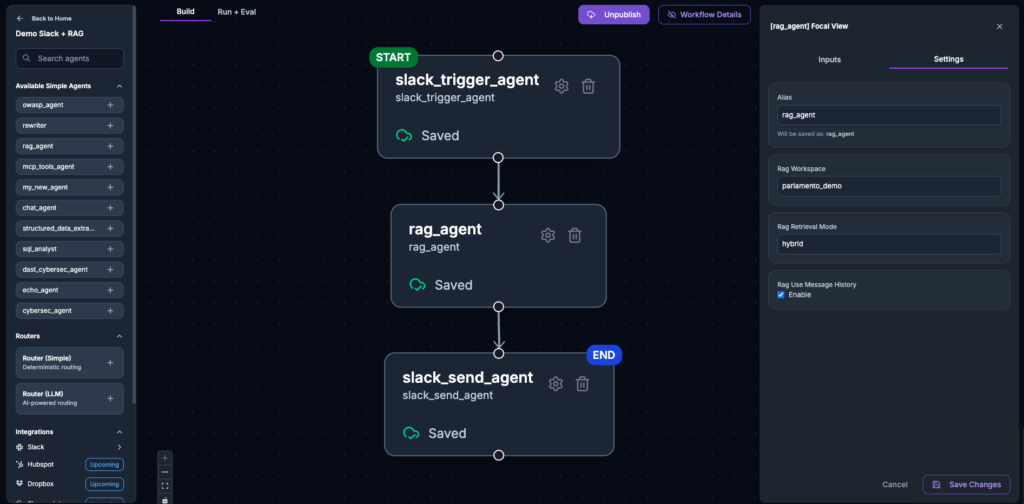
To include the RAG Agent in a workflow, the process is simple: just drag and drop the rag_agent node from the left sidebar, and connect it with other workflow components such as routers, Slack integrations, or chat agents. This enables rapid composition of end-to-end AI workflows with minimal effort.
Accelerating Enterprise AI, Responsibly
With QBricks, organizations can stop funding agent pilots and start operating a true Agent OS, deploying agents that are secure, compliant, observable, and scalable from day one.
It represents Qubika’s commitment to helping enterprises realize real, measurable value from AI, faster and with less risk.
To learn more about QBricks and Qubika’s AI services and capabilities, visit qubika.com/agentic-factory