













In 2025, Databricks introduced Databricks One, a new consumption-focused experience within the Databricks Data Intelligence Platform. Its goal is simple but ambitious: make data and AI accessible to business users without requiring them to understand clusters, notebooks, SQL, or data engineering workflows.
But beyond being a new interface, Databricks One represents a strategic evolution. It shifts the lakehouse from being primarily an engineering environment to becoming a direct decision-making surface for the business.
This article explores what Databricks One is, how it works, and what organizations should consider before adopting it.
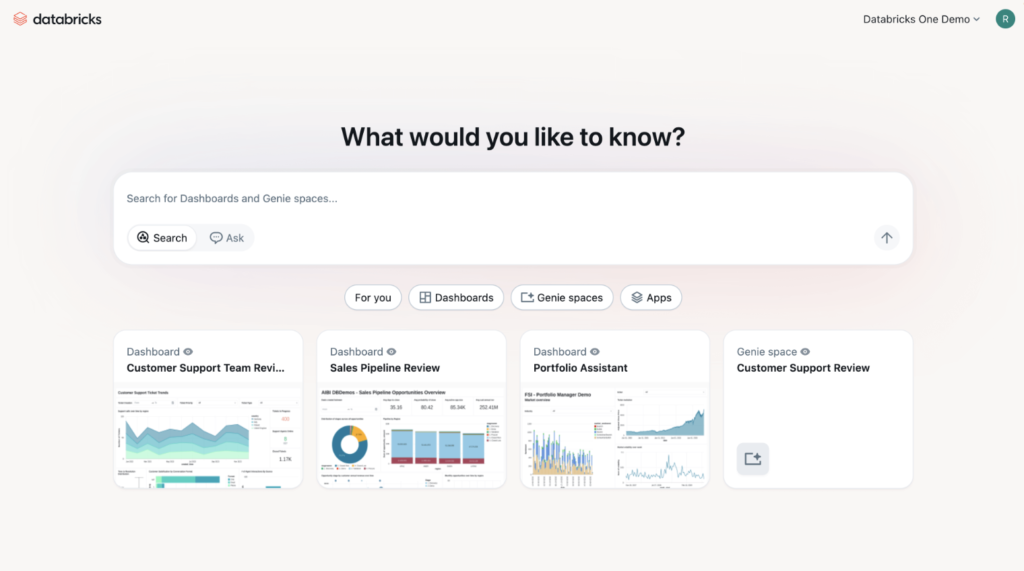
A Unified Entry Point for Business Intelligence with Databricks One
Databricks One provides a streamlined homepage where users can:
-
View AI/BI dashboards
-
Interact with AI/BI Genie using natural language
-
Launch custom Databricks Apps
-
Navigate domain-organized content
The experience is intentionally minimal. It removes exposure to technical workspace elements and surfaces only curated assets relevant to the user’s role.
For business teams, this means faster access to insights without needing training in data tools. For data teams, it means a controlled, governed consumption layer built directly on top of the lakehouse.
Conversational Analytics with AI/BI Genie
One of the most powerful components of Databricks One is AI/BI Genie, a conversational interface that allows users to ask questions in plain language.
Examples:
-
“Why did revenue drop in April?”
-
“Show customer churn trends over the last quarter.”
-
“Which region had the highest margin growth?”
Genie translates these questions into SQL, executes them against governed data, and returns results as visualizations or explanations.
When backed by well-modeled data and defined business metrics, Genie can significantly reduce decision latency, turning days of analysis into minutes.
However, conversational analytics requires discipline. Data must be curated, metrics standardized, and governance enforced. Without a strong semantic layer, even the best AI assistant cannot guarantee trustworthy answers.
AI/BI Dashboards Built on the Lakehouse
Databricks One enables business users to interact with dashboards built directly on the lakehouse. These dashboards:
-
Update in real time
-
Support filtering and drill-down analysis
-
Operate under Unity Catalog governance
-
Use serverless SQL warehouses for execution
Because they run natively within the platform, there is no data replication, no extract pipelines, and no governance fragmentation. Row-level security, column masking, and audit logging apply automatically.
This unified model reduces operational complexity and strengthens compliance posture. Especially in regulated environments.
Databricks Apps: From Insight to Action
Beyond dashboards and conversational analytics, Databricks One surfaces Databricks Apps. Custom applications built on top of data and AI workflows.
These apps can support:
-
Budget planning
-
Operational monitoring
-
Campaign analysis
-
Domain-specific analytics workflows
Instead of sharing links or scripts, organizations can publish applications directly into the One interface, making them discoverable and accessible to business users.
This expands the lakehouse from an analytics backend to an application delivery layer.
Governance by Design
Databricks One inherits its governance model from Unity Catalog, meaning:
-
Row-level security policies apply automatically
-
Column masking is enforced consistently
-
All activity is auditable
-
Permissions are centrally managed
This unified governance eliminates discrepancies between technical and business interfaces. Data teams define access once, and it applies everywhere.
For organizations scaling AI adoption, this consistency is critical.
Cost Considerations
Databricks One does not introduce additional licensing costs. It is included within the Databricks platform.
However, compute usage still applies.
Dashboards and Genie queries consume SQL warehouse resources. As adoption grows, particularly in large enterprises, monitoring query patterns, concurrency, and warehouse configuration becomes essential.
Organizations should:
-
Define warehouse sizing strategies
-
Implement monitoring for query cost
-
Use semantic modeling to prevent inefficient queries
-
Pilot rollout by domain before enterprise-wide deployment
Conversational analytics can be powerful, but without guardrails, it can also be expensive.
Where Databricks One Delivers the Most Value
Databricks One is particularly effective in environments where:
-
Data already lives in the lakehouse
-
Governance through Unity Catalog is established
-
Business teams require self-service analytics
-
AI-driven exploration is a priority
-
Reducing BI tool fragmentation is a goal
It shines as a unified consumption layer that connects governed data, dashboards, AI, and applications into a single experience.
Important Limitations to Consider
Databricks One is a consumption interface, not a development environment.
Users cannot:
-
Transform data
-
Build pipelines
-
Create new datasets
-
Edit notebooks
It depends on strong collaboration between data teams and business teams.
Additionally, conversational AI is only as reliable as the data model beneath it. Poorly structured data or inconsistent metric definitions will reduce trust in results.
Adoption should be intentional, structured, and supported by governance best practices.
A Strategic Shift in the Lakehouse Model
Databricks One represents more than a UI improvement.
It reflects a broader shift in how data platforms are evolving, from backend infrastructure to business-facing intelligence systems.
By integrating conversational AI, governed dashboards, and application delivery into a single interface, Databricks is positioning the lakehouse as not just a storage and processing engine, but a decision platform.
For organizations investing in AI and data at scale, this shift matters.
Final Thoughts
Databricks One is not about replacing tools. It is about simplifying access to intelligence.
When paired with strong governance, curated metrics, and clear domain ownership, it can significantly accelerate business decision-making while maintaining enterprise-grade security and control.
The key to success lies not in enabling the feature, but in designing the ecosystem around it.
Data quality, semantic modeling, governance, and cost monitoring will determine whether Databricks One becomes a transformative asset or simply another interface.
Used thoughtfully, it has the potential to bring data intelligence directly into the hands of those who need it most.
Explore our Databricks services
Qubika is a Databricks Gold Partner with 200+ certified engineers across data, AI, and ML. Whether you're adopting Lakeflow, migrating existing pipelines, or designing a lakehouse from scratch, our team brings hands-on platform experience to every engagement.