










How tokenization helps teams move faster by focusing on what actually matters
Design Systems are often associated with visual consistency and component reuse. While that’s part of the story, it’s not where their real value lies. In practice, a Design System becomes truly impactful when it changes how teams work: how fast they move, how well they align, and where they invest their time.
I’ve experienced this while leading Hiedra, an internal framework at Qubika used by designers across projects to build, audit, and evolve Design Systems at different levels of maturity. Working on Hiedra, across different stacks like MUI, Untitled, and Chakra, reinforced one core idea: design and development accelerate when UI decisions stop being reinvented and start being shared infrastructure.
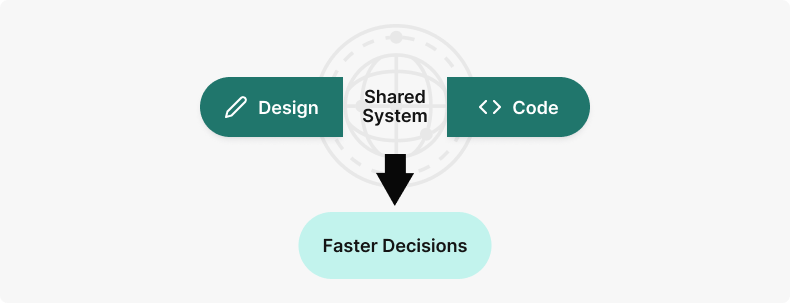
Speed is lost in decisions, not in execution
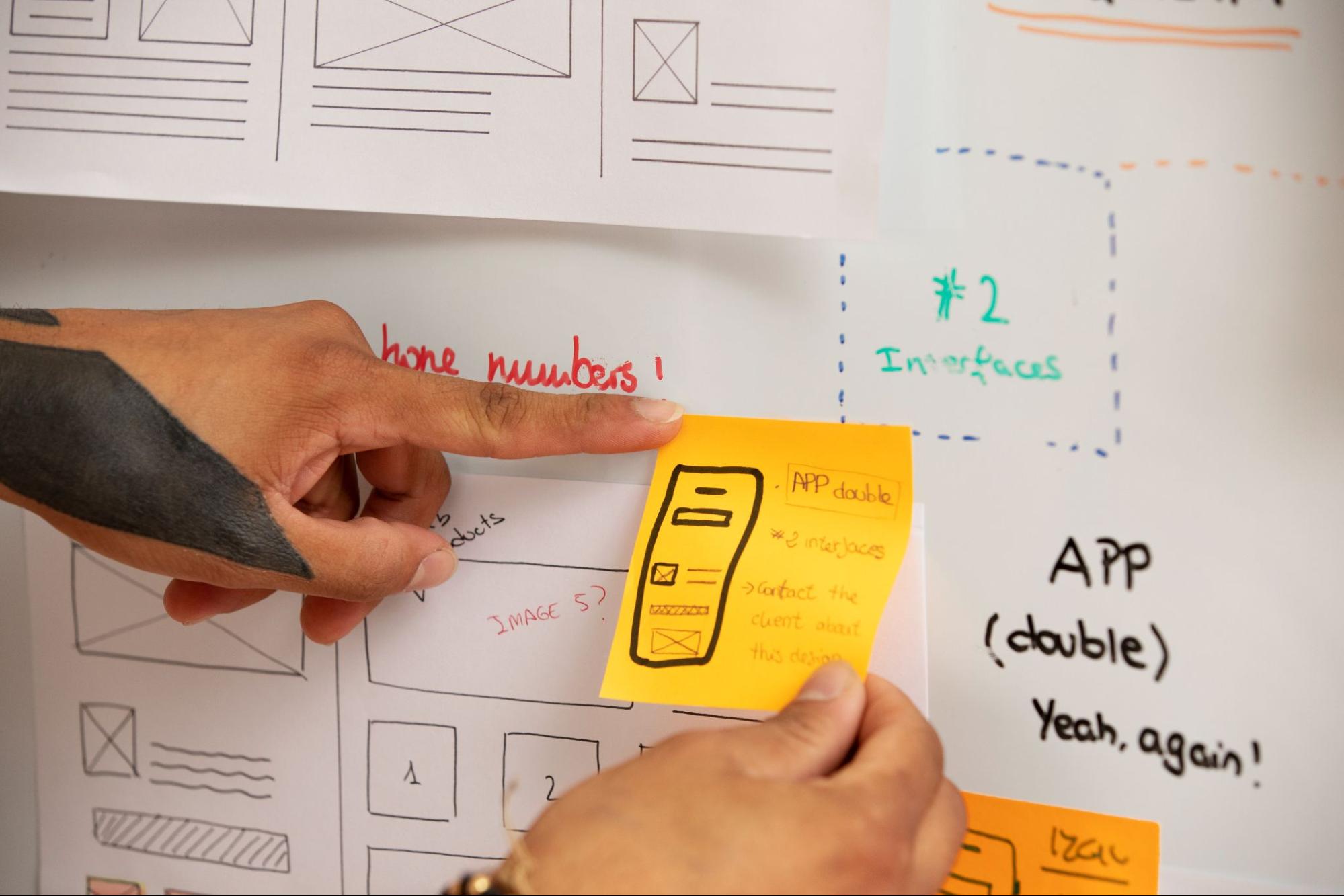
Most product teams don’t slow down because they can’t design or build screens. They slow down because the same questions keep coming up:
- What spacing should we use here?
- Which color is correct in this context?
- How does this behave in dark mode?
- What’s the standard for states, truncation, or edge cases?
When those answers are not encoded in a system, every feature becomes a negotiation. Designers make local decisions, developers interpret them, and alignment depends heavily on individual experience. This is where friction, rework, and inconsistencies quietly accumulate.
A tokenized Design System changes that dynamic by turning UI decisions into agreements that both design and development share.
From styles to systems: what actually changed
Styles were the natural starting point. They helped teams reuse visual decisions and maintain basic consistency. In many ways, they acted as a branding layer inside design files: reliable, repeatable, and familiar.
The limitation is that styles are static. They store values, but they don’t express intent or adapt well to context.
Variables and tokens expanded that model. Instead of relying on memory or visual approximation, teams can work with structured values (numbers, colors, booleans) that respond to modes, states, and conditions. Design files start to behave less like static canvases and more like systems.
This doesn’t mean styles disappear. Text styles still define hierarchy and structure, while variables control specific values like spacing, sizing, or letter spacing. Color, however, is where tokenization becomes unavoidable: semantics and modes scale much better when color is treated as data, not as a fixed visual choice.
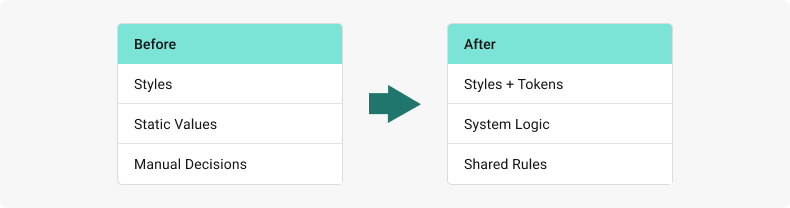
This hybrid approach is what brings design closer to how products are actually built in code, and that alignment is a key driver of speed.
Parity, scalability, and consistency as real accelerators
The biggest advantage of a tokenized Design System is parity between design and development.
When both disciplines rely on the same conceptual model, handoff becomes clearer. There are fewer clarifying questions, less interpretation, and fewer one-off decisions in code. The Design System becomes a shared contract instead of a reference artifact. This shared contract is what allows Design Systems to scale across products and teams while maintaining consistency over time.
Maintaining Hiedra across multiple libraries reinforced a practical truth: tokenization must adapt to the technology it serves. Each stack interprets tokens differently, so scalability comes not from rigid standardization, but from aligning on principles and intent.
Adoption is what drives acceleration. A system that fits real workflows is a system that actually gets used.
What happens after the system is built
Building a tokenized Design System takes real effort. Defining scales, semantics, naming, and alignment across teams is not trivial and shouldn’t be underestimated.
But once that work is done, something important happens: the system stops being the center of daily discussion.
In many products, the Design System doesn’t need constant expansion. The product evolves, but often not in ways that require new tokens or structural changes. What remains is mostly maintenance, including small refinements and occasional updates.
That stability is where the real value appears. When UI rules are already defined and trusted, teams stop spending time debating visual details. The system carries those decisions, and designers can move on. That stability is what keeps products consistent as they evolve and scale, without requiring constant redesign or rework.
Designing products in an AI-accelerated world
AI is accelerating every part of the product creation process. Designing interfaces, prototyping flows, and even generating production-ready code is becoming faster and more accessible every day.
This doesn’t mean UI details are no longer needed. They still matter, and they need to be done well. But they shouldn’t consume the core of the team’s energy indefinitely.
Tokenized Design Systems help teams close the UI layer at the right moment. By defining styles, rules, and tokens early, the visual foundation becomes stable and predictable. UI decisions are resolved, not ignored.
This level of structure becomes increasingly important as AI-driven tools and agents enter the workflow. When Design Systems are well defined, AI agents, MCP-based workflows, and tools like Figma Make or Lovable can rely on them as a source of truth. Components behave consistently, tokens are interpreted correctly, and automated generation doesn’t introduce unnecessary drift.
That stability allows teams to use AI for what it’s best at: accelerating exploration. Low-fidelity prototyping, rapid brainstorming, and early experimentation become safer and more effective because the system already provides guardrails.
With the UI layer stable, teams can focus on what truly makes a product stand out in the market: understanding users, analyzing real needs, designing meaningful flows, and validating decisions through empathy rather than aesthetics.
In a world where building is fast, execution alone is not the differentiator.
Beyond prompts: the role of the product designer
Knowing how to use AI tools or write effective prompts is not the same as designing good products. Without a deep understanding of users, context, and constraints, fast execution often leads to fast failure.
This is where product design creates real value. Empathy, critical thinking, and attention to edge cases cannot be automated away.
Tokenized Design Systems don’t compete with AI; they complement it. By removing low-value UI debates from the workflow, they protect the space teams need to think clearly and design experiences that actually work.
Final takeaway
As execution accelerates, teams can shift their focus from how things are built to why they are built.
Tokenized Design Systems don’t remove UI work; they prevent it from dominating the process. By encoding decisions early, they free teams to focus on understanding users, designing meaningful flows, and solving real problems.
In an AI-accelerated world, speed alone is not the advantage.
Building the right product is.
Product Design Studio
Craft captivating & memorable designs. We offer end-to-end product design services from UX research and UX/UI to visual design and service design that considers the full user experience beyond the product.