












More than 36,000 engineers, technologists, and innovators gathered in Nuremberg, Germany for Embedded World 2026, one of the most important events in the embedded systems industry.
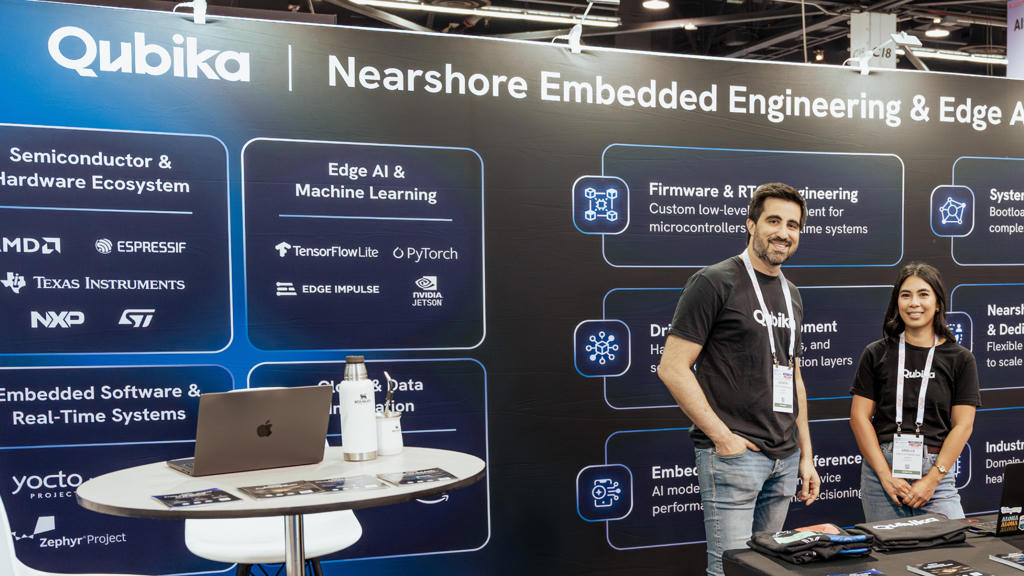
We at Qubika were there, showcasing the capabilities of our Embedded Engineering Studio and connecting with leaders shaping the future of intelligent devices.
Several clear shifts emerged – pointing to a future defined by distributed intelligence, edge-native AI, and built-in security.
The Octopus Model: Decentralization Is King
One of the most memorable ideas from the opening keynote was the “Octopus Model.” Instead of relying on a central processor, systems are increasingly distributing intelligence across devices—much like an octopus processes information through its tentacles.
In this architecture, sensors, peripherals, and edge devices can act independently, making decisions locally without waiting for instructions from a central hub. The result is lower latency, greater resilience, and more scalable systems.
AI Moves to the Edge
The most dominant trend across the show floor was the acceleration of AI at the edge – or what is increasingly referred to as Physical AI.
Rather than relying on cloud-based inference, AI is being embedded directly into devices:
- AI-enabled MCUs and SoCs
- On-device inference for vision, robotics, and automation
- Ultra-low power AI chips for battery-powered systems
We saw strong momentum behind edge vision processors, AI robotics platforms, and inference-ready embedded systems, all designed to sense, decide, and act locally.
The strategic implication is clear: AI acceleration is moving down the silicon stack – from edge SoCs into MCUs, and increasingly into sensors themselves.
The Rise of AI-Enabled Microcontrollers
Closely tied to this trend is the rapid emergence of AI-capable microcontrollers.
Vendors introduced new MCU families featuring:
- Integrated neural processing engines
- tinyML-optimized architectures
- AI frameworks tailored for constrained environments
Notably, Texas Instruments announced new MCU platforms designed to bring AI into everyday embedded devices, reinforcing a broader industry shift of AI becoming a standard capability at the firmware level.
This marks a transition where machine learning inference is embedded directly into core device logic, enabling smarter, more autonomous systems at scale.
RISC-V Gains Strategic Momentum
RISC-V continues to gain traction as a flexible, vendor-neutral architecture, particularly across:
- Industrial IoT
- Automotive platforms
- Edge AI accelerators
A key development is the rise of custom AI accelerators built on RISC-V, allowing organizations to tailor silicon to specific workloads while maintaining ecosystem flexibility.
As tooling and software maturity improve, RISC-V is positioning itself as a strategic alternative in performance- and cost-sensitive embedded designs.
Arduino Goes Industrial
Arduino made waves with the VENTUNO Q, introducing a dual-brain architecture that combines a high-performance processor with a real-time microcontroller.
This design bridges rapid prototyping and industrial reliability, signaling Arduino’s evolution from a hobbyist platform to a serious contender in industrial control and edge AI applications.
The EU Cyber Resilience Act (CRA) Is Driving Change Among Embedded Manufacturers
Security was a major topic across the show floor due to the EU Cyber Resilience Act (CRA). For embedded manufacturers, this translates to cybersecurity being a regulatory mandate and a market access requirement. Organizations must treat security as a core design principle throughout the product lifecycle, ensuring compliance from architecture through deployment and long-term maintenance.
Tools for SBOM generation, vulnerability scanning, and secure firmware management were everywhere, reflecting a shift toward security-by-design across the industry.
Raspberry Pi Goes Industrial
The Raspberry Pi Compute Module 5 (CM5) is accelerating the platform’s transition into industrial environments.
At Embedded World, we saw a growing ecosystem of industrial carrier boards, smart display modules, and DIN-rail systems built around the CM5—making Raspberry Pi a practical foundation for smart factories and professional embedded systems.
Embedded-1x1-feed
Final Thoughts on Embedded World 2026
Embedded World 2026 made it clear that the future of embedded systems is decentralized, AI-powered, and security-first. At Qubika, the event provided a valuable opportunity to engage directly with these industry shifts and demonstrate how our Embedded Engineering Studio enables organizations to design, build, and scale the next generation of intelligent devices.