













Modernizing revenue intelligence with a unified metrics foundation
In this article we’ll explain how Databook achieved:
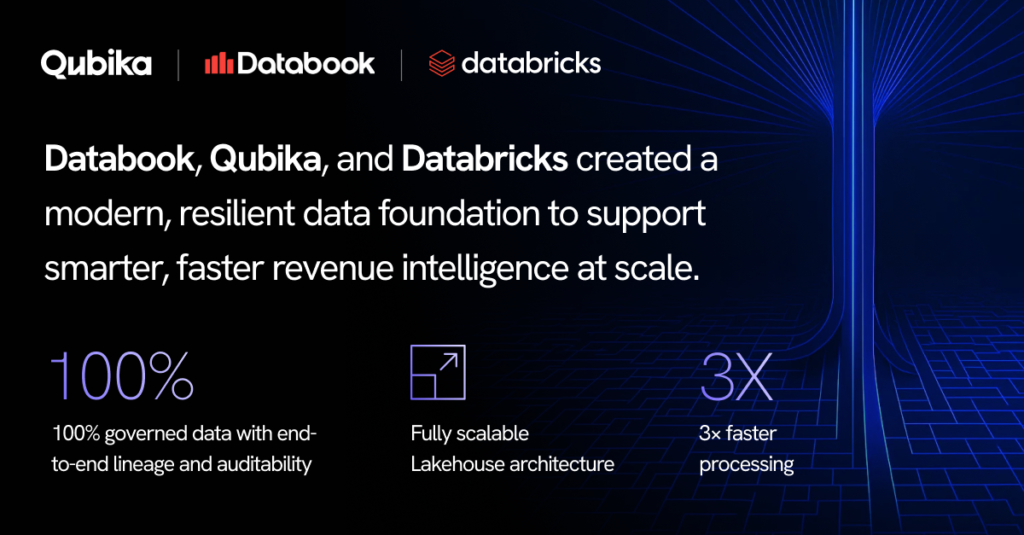
- 3× faster processing times. Metric computation cycles reduced from hours to minutes.
- 100% governed data. End-to-end lineage, access control, and auditability with Unity Catalog.
- A fully scalable architecture. A Lakehouse architecture designed to grow with product and data needs.
A modern platform powering B2B revenue intelligence
Databook is a B2B revenue intelligence company that equips enterprise sales teams with insights into financial performance, business drivers, and strategic opportunities. These insights rely on a broad set of metrics derived from public company filings, operational data, and proprietary calculations.
As Databook grew, its legacy system made it increasingly difficult to maintain the consistency, quality, and timeliness required to deliver trusted insights. The company needed a unified data foundation to support more reliable decision-making and to keep pace with the evolving expectations of modern go-to-market teams.
Fragmented pipelines slowed insight delivery
Databook’s previous architecture relied on a distributed set of services across Node.js, MongoDB, PostgreSQL, Kafka, and Snowflake. Metric logic was custom-coded, difficult to trace, and slow to evolve.
This created several challenges:
- Disconnected data pipelines made reprocessing and auditing difficult
- Lack of lineage slowed debugging and reduced trust in metric outputs
- Adding or modifying metrics required heavy engineering work
- Processing windows took hours, delaying insights for downstream teams
- No unified semantic layer for cross-team alignment
Databook needed a modern platform that could unify ingestion, governance, and metric computation in a scalable, transparent way.
A Lakehouse-powered Metrics Store built for scale
In partnership with Qubika, Databook rebuilt its metric computation layer on the Databricks Lakehouse Platform, adopting a declarative, governed architecture designed for reliability and future growth.
A declarative Metrics Store
Qubika introduced a consistent, maintainable approach to defining and computing metrics:
- YAML-based metric definitions with a clean data model
- Automated PySpark code generation using Jinja2 and sqlglot
- A structured resource layout hosted on Unity Catalog volumes
- A lineage viewer providing full visibility into metric dependencies
- A CI/CD pipeline powered by Databricks Asset Bundles
This shifted Databook from custom-coded logic to a standardized semantic layer that is easier to maintain and evolve.
A unified Lakehouse architecture using core Databricks services
Databook’s new platform adopts the best of Databricks:
- Delta Lake as the central storage layer for all metric outputs
- Delta Live Tables (DLT) for orchestrating the ingestion and transformation of core entities
- PySpark for scalable, distributed metric computation
- Unity Catalog for governance, lineage, RBAC, and auditability
- Databricks SQL for analytics and validation queries
- Databricks Workflows automatically generated for each metric pipeline
- Asset Bundles for automated deployment and environment consistency
- MkDocs for centralized documentation
This modern Lakehouse foundation delivers reliability, consistency, and transparency across Databook’s metric ecosystem.
Measurable impact
The impact achieved was very significant:
- 3× faster metric processing. Distributed PySpark pipelines and Delta Lake drastically reduced processing cycles.
- 100% governed platform. Unity Catalog enforces fine-grained access control, lineage, and auditability across all metric tables and workflows.
- Increased development velocity. A declarative YAML model enables new metrics to be added or updated without rewriting code.
- Operational reliability. DLT and Asset Bundles ensure stable, observable, and consistently deployed pipelines.
- Greater cross-team alignment. A unified semantic layer ensures product, data, and engineering teams work from the same definitions.
A trusted foundation for revenue intelligence
By rebuilding its metric architecture on the Databricks Lakehouse, Databook replaced a fragmented set of pipelines with a governed, scalable, and transparent metrics foundation.
The result is a platform that:
- Delivers fresher and more reliable insights
- Reduces operational overhead
- Simplifies metric evolution
- Improves trust and consistency across the business
Databook, Qubika, and Databricks have created a modern, resilient data foundation that supports smarter, faster revenue intelligence at scale.