













Enterprise data engineering has reached an important inflection point.
The market is no longer defined primarily by which platform an organization selects or whether it has moved workloads to the cloud. According to AIM Research’s Top Data Engineering Service Providers 2026 report, the architectural debate is increasingly settled. Lakehouse patterns, decoupled storage and compute, medallion architectures, lineage, access controls, encryption, and CI/CD-driven DataOps have become standard expectations across credible providers.
What now differentiates data engineering leaders is their ability to deliver production-grade platforms that remain reliable, governed, scalable, and economically sustainable after implementation. In AIM’s framing, operational proof is becoming more important than architectural promise.
The lakehouse is now the baseline, not the differentiator
The standardization of modern data architecture is one of the report’s clearest conclusions.
Open table formats, cloud-native storage, elastic compute, medallion architectures, and integrated governance have become widely adopted. As a result, simply presenting a modern lakehouse architecture is no longer enough to demonstrate maturity.
Data engineering leaders must now show that their platforms can withstand production scale. That includes sustained SLA performance, predictable recovery times, workload isolation, observability, cost control, and stable operations after the initial delivery team leaves.
For data leaders, this changes the vendor evaluation process. Architecture diagrams still matter, but named production references, operational metrics, and evidence of long-term platform durability matter more.
AI-readiness is redefining the scope of data engineering
AIM argues that data engineering is increasingly evaluated as AI infrastructure rather than simply an analytics enabler.
The required foundation now extends beyond structured data pipelines. Enterprises are introducing vector-compatible storage, feature stores, knowledge graphs, ontologies, semantic layers, data contracts, and freshness guarantees to support GenAI, RAG, and agentic workloads.
The report identifies GenAI and RAG pipelines as the fastest-growing workload segment among providers. However, it also warns that maturity varies considerably. The more credible providers can explain how they govern model inputs, maintain lineage, enforce quality, and move AI workloads into production. Less mature firms may simply rebrand unstructured ingestion as an AI-ready architecture.
For enterprise leaders, the implication is straightforward: an AI strategy without an AI-ready data architecture is unlikely to scale.
Migration is evolving from lift-and-shift to industrialized modernization
Migration remains a major part of the market, but its form is changing. Pure lift-and-shift programs are declining. Growth is moving toward cross-warehouse migrations, legacy ETL modernization, schema conversion, dependency analysis, code translation, and platform refactoring for AI-readiness.
AIM highlights the rise of “migration factories”: metadata-driven frameworks and LLM-assisted transpilers that automate previously manual work such as dependency mapping, lineage extraction, schema conversion, and legacy code transformation.
This matters because cloud migration alone does not eliminate technical debt. Without refactoring and governance, organizations risk reproducing the same complexity in a more expensive environment.
The strongest modernization programs therefore measure success not by the number of workloads moved, but by the reduction of legacy debt, operating cost, time-to-value, and future AI readiness.
Agentic AI is beginning to transform delivery itself
One of the more consequential trends in the report is the use of AI inside data engineering delivery.
Providers are applying agents and AI-assisted tools to pipeline scaffolding, schema mapping, transformation logic, test generation, metadata extraction, lineage, observability, incident triage, and root-cause analysis.
AIM also identifies self-healing pipelines and automated first-line remediation as emerging production capabilities. This is beginning to blur the boundary between data engineering and platform operations.
For buyers, the relevant question is not whether a provider uses AI-assisted development. That is quickly becoming common. The more important question is whether this automation produces measurable gains in delivery speed, quality, reliability, or MTTR – and if they properly use guardrails and data security measures.
Governance is moving into the engineering lifecycle
The report treats governance as an engineering capability rather than a documentation exercise.
Programmatic data contracts, automated quality rules, lineage capture, masking, access policies, and compliance controls are increasingly being embedded directly into pipelines and deployment workflows.
This “shift-left” model addresses one of the recurring causes of data platform failure: governance arriving after the architecture has already been built.
When controls are introduced late, security reviews, access approvals, stewardship, and remediation can delay programs more than the engineering itself. When they are built into ingestion, CI/CD, and platform provisioning, governance becomes a mechanism for accelerating trusted delivery.
For regulated enterprises in particular, governance-as-code is becoming a core requirement.
FinOps has become part of architecture design
AIM also identifies a significant shift in cloud cost management.
FinOps is moving from backward-looking cost review to forward-looking engineering discipline. Mature providers are designing platforms around unit economics, workload isolation, automated compute tiering, autoscaling, query optimization, cost observability, and chargeback models.
The report emphasizes that technical optimization alone is insufficient. Effective cost control also requires operating-model accountability across teams.
This is especially important as AI workloads increase demand for compute. A platform may be technically scalable but economically unsustainable. Data engineering leaders therefore need to evaluate cost per workload, query, pipeline, business unit, and use case—not simply overall cloud consumption.
Accelerators are becoming important, but buyers need evidence
The data engineering services market is saturated with accelerators.
AIM groups them into four broad categories:
- pipeline and transformation assets
- platform and infrastructure assets
- quality, governance, and observability assets
- cost, performance, and reliability optimizers
The report’s warning is that not all IP is equal.
Some accelerators are little more than reference frameworks or demonstration assets. Others are production-hardened and actively used to reduce build effort, improve reliability, automate governance, or lower cost.
Buyers should therefore ask where an accelerator has been deployed, what engineering problem it solves, how frequently it is reused, and what measurable impact it has produced.
Talent scarcity is reshaping engagement models
AIM links persistent engineering talent shortages with a broader shift in procurement.
High turnover can leave critical institutional knowledge buried inside undocumented pipelines and individual engineers. When those people leave, platform reliability deteriorates.
As a result, organizations are moving beyond traditional staff augmentation toward managed services, Build-Operate-Transfer models, joint centers of excellence, and outcome-linked commercial structures.
This shift reflects a change in what buyers value. Headcount is becoming less important than accountability, knowledge retention, operational resilience, and measurable outcomes.
Data mesh is facing an operational reality check
The report takes a pragmatic view of data mesh.
The model remains strategically relevant where centralized data teams have become bottlenecks. However, many implementations fail to progress beyond domain definition because organizations struggle with ownership, governance, product management, and operating-model change.
AIM suggests that data fabric is gaining traction as a more governable approach that preserves interoperability while reducing some of the organizational complexity associated with mesh.
For data leaders, the lesson is to prioritize operability over architectural purity. A technically elegant model that internal teams cannot sustain is not a successful target state.
Qubika recognized as a Leader
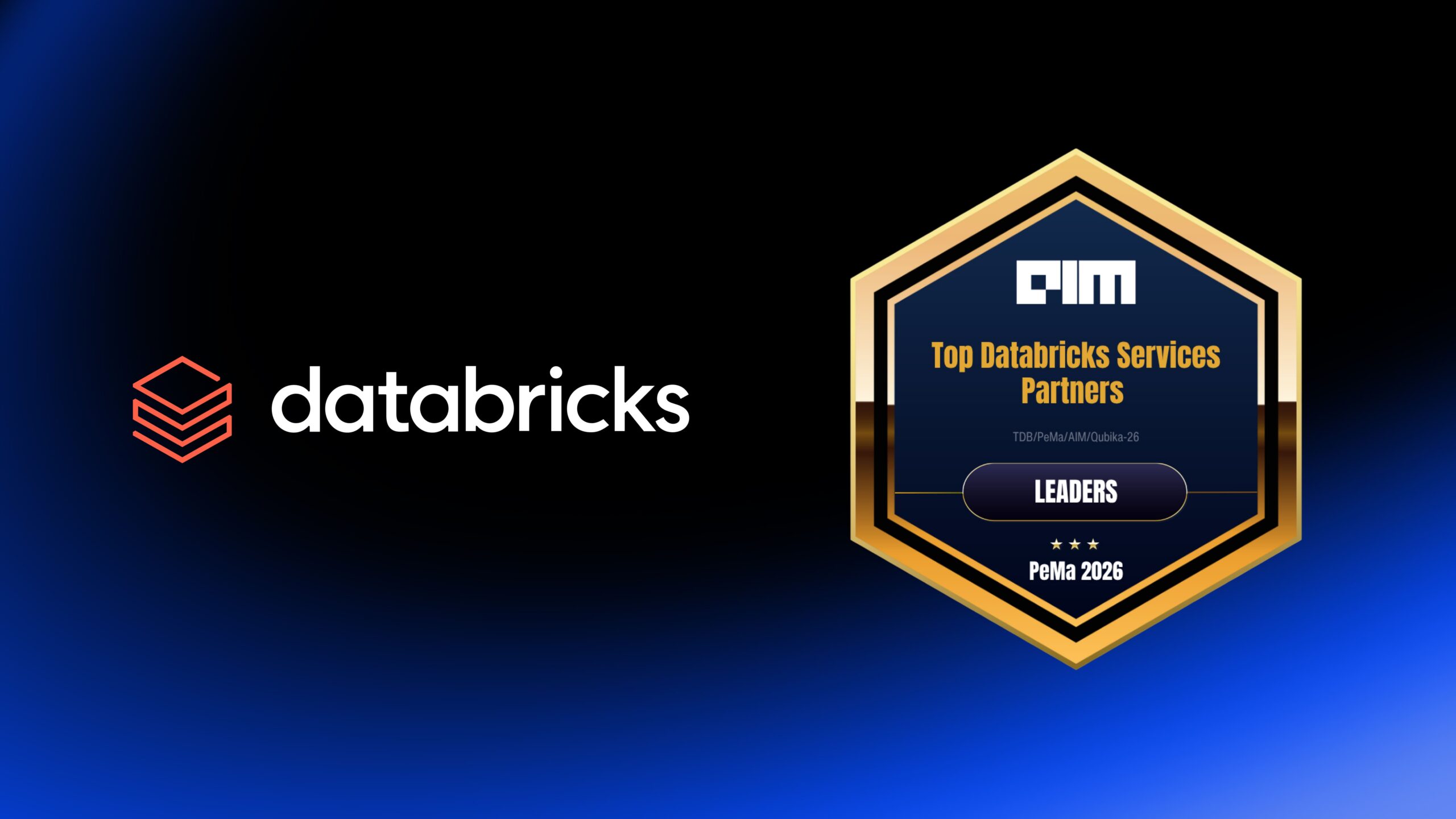
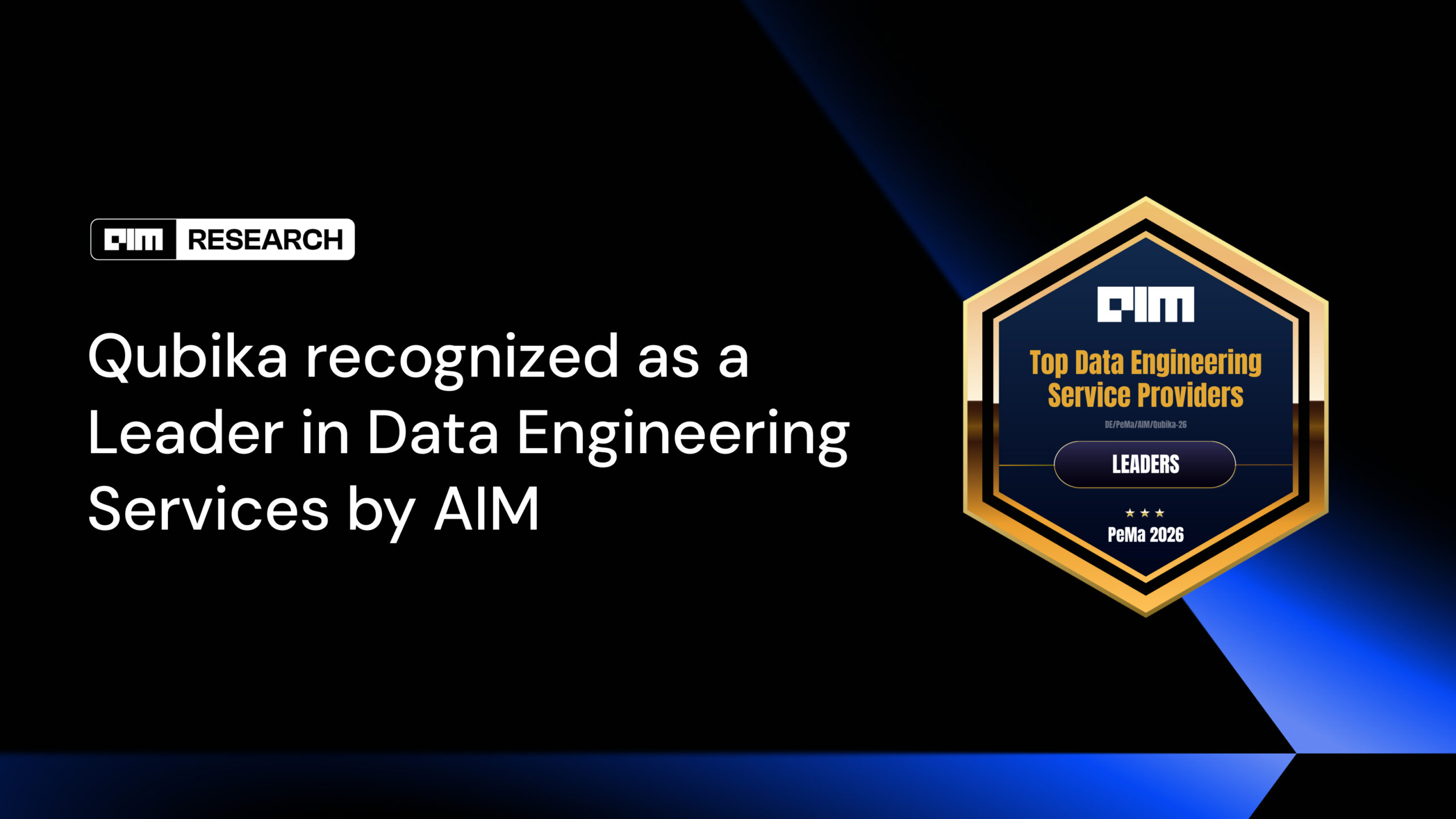
Within this changing market, AIM Research positioned Qubika in the Leaders quadrant of its 2026 PeMa evaluation.
AIM assesses providers across Market Penetration and Technology Maturity, considering factors including client reach, growth, production delivery, innovation, scalability, risk management, team maturity, and support infrastructure.
The research highlights several Qubika strengths that align directly with the market trends described above.
AIM recognizes Qubika’s lakehouse-first and AI-enablement approach, spanning strategy, ingestion, platform engineering, governance, DataOps, MLOps, GenAI enablement, and managed services. It also notes Qubika’s use of medallion architectures, reusable ingestion frameworks, idempotent pipeline design, CI/CD, streaming technologies, and cost-aware compute governance.
The report specifically highlights Qubika’s proprietary accelerator portfolio. Its Unity Catalog Setup Accelerator and Governance Migration Agent are cited as reducing governance setup and migration effort by up to 90%. AIM also points to QBricks, MultiFormat Parsing Agent, Unstructured Knowledge Assistant, and GraphRAG as examples of assets that help convert enterprise data into governed, AI-ready foundations.
AIM further recognizes Qubika’s AI-native, senior-led delivery model, production reliability, security posture, Databricks ecosystem position, and depth in financial services and media. The report cites strong SLA adherence, SOC 2 Type II and ISO/IEC 27001:2022 certification, and alignment with the NIST AI Risk Management Framework.
“As enterprises expand beyond traditional analytics to generative and agentic AI, the focus is shifting toward building trusted, AI-ready data foundations that can support intelligent applications at scale.
Qubika combines platform-agnostic data engineering expertise with strong capabilities across leading cloud data platforms. Its mature Databricks practice and extensive pool of certified specialists underscore its technical depth, enabling organizations to modernize enterprise data foundations, implement governed lakehouse architectures, and establish AI-ready environments for the next generation of generative and agentic AI applications.”
What data engineering leaders should do next
The report points to a more demanding set of priorities for enterprise data leaders.
Modernization programs should be evaluated against their ability to create AI-ready foundations, not just complete cloud migrations. Governance and FinOps should be embedded into architecture from the beginning. Providers should be assessed on production outcomes, not breadth of capability claims. Accelerators should be validated through live deployment evidence. And operating models should be designed for durability after external teams rotate off.
See the Full Analyst Assessment of Qubika
Qubika was recognized as a Leader in AIM Research's 2026 Data Engineering Services PeMa Quadrant, reflecting its strong technology maturity and market presence. The report highlights Qubika's lakehouse-first, AI-enabled approach to data engineering, combining modern platform engineering, governance, DataOps, and GenAI enablement. AIM also recognizes Qubika's proprietary accelerator portfolio, AI-native delivery model, production reliability, and deep Databricks expertise, enabling organizations to modernize their data foundations and accelerate the adoption of enterprise AI.