





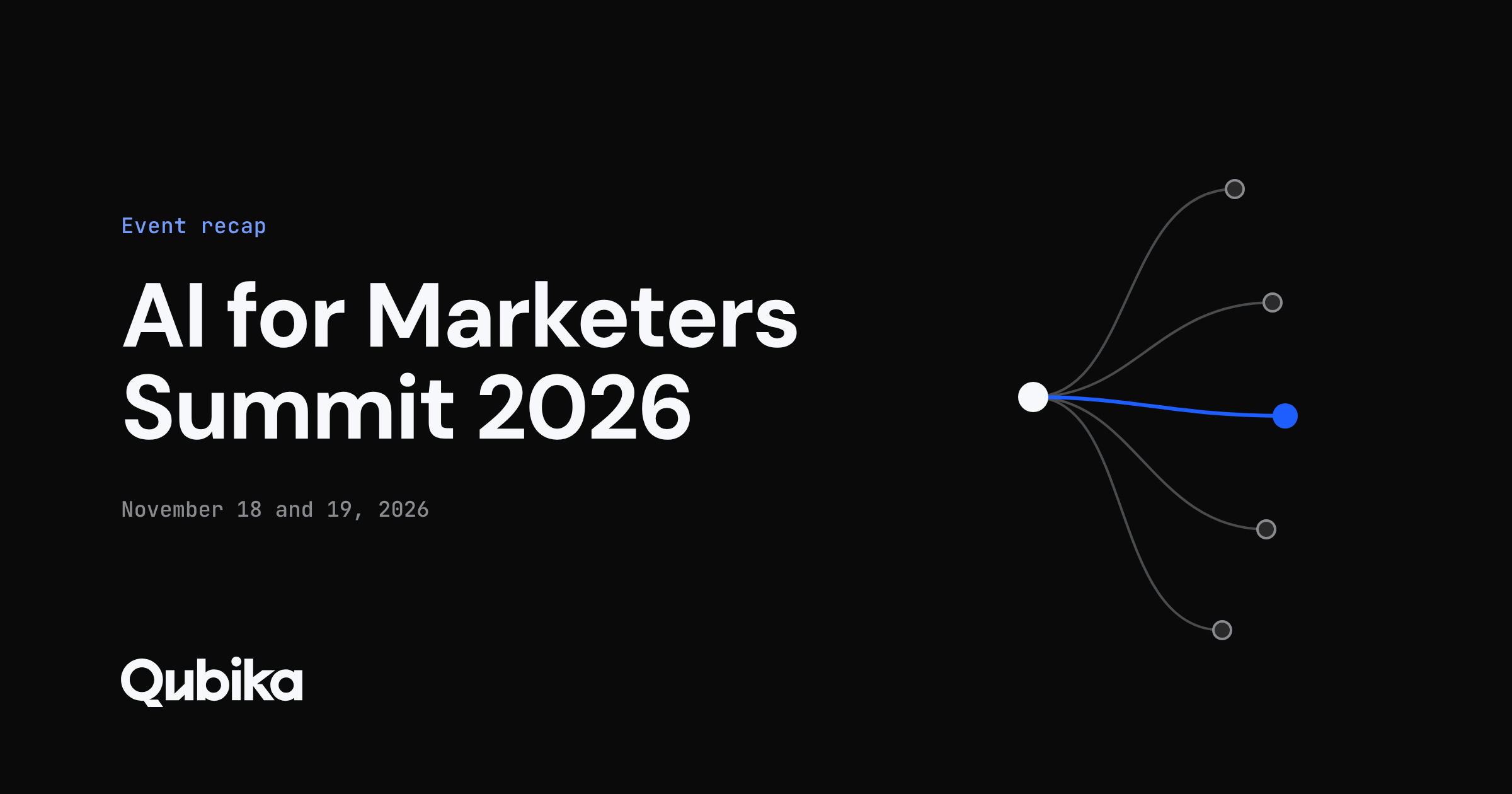





For two days, on November 18 and 19, 2026, the AI for Marketers Summit brought marketing leaders together in a virtual edition, ahead of its first in person edition in Las Vegas in February 2027. Qubika joined as a media partner.
The short answer: AI is changing how buyers discover and evaluate brands. The teams pulling ahead measure how they show up in AI answers, give their AI tools trusted context, and keep people accountable for every decision. Here are the highlights.
What is the AI for Marketers Summit?
The AI for Marketers Summit, organized by GSMI, focuses on how marketing teams apply AI to strategy, content, analytics and go to market. The November 2026 virtual edition ran over two days with sessions on AI visibility, adoption, analytics and GTM intelligence.
The next stop is the first in person AI for Marketers Summit, February 23 to 25, 2027, at the Rio Hotel & Casino in Las Vegas.
How do brands appear in AI answers?
Jason Khoo, Founder and CEO of Zupo, opened with the concept every marketer working on AI visibility needs to understand: query fan out.
When someone asks an AI assistant a question, the model breaks the prompt into many related searches, checks multiple sources and builds the answer from what it finds. That means:
- One prompt becomes many searches.
- Those searches shape the answer.
- Visibility depends on the fan out.
In his words, query fan outs are the new keywords. The clearest signal that fan out is happening: the model says it is searching the web, or the answer shows sources and citations.
Where to start? Measure. “Visibility is the new rankings.” A solid AI visibility program tracks:
- AI visibility percentage
- Prompt tracking
- Competitor tracking
- Source tracking
He also shared four types of prompts worth tracking: vendor search (“what are the top companies for X”), sentiment (pros and cons of a specific provider), market positioning (direct comparisons) and brand accuracy (whether AI describes your offer correctly).
The case that made it real. A software company had 0% visibility across ChatGPT, Perplexity and Google AI Overviews for the core prompt in its category. The team mapped the fan out queries, found that one query was used again and again, and focused the entire campaign on it, including third party content. Between August and December, visibility for that prompt went from 0% to 70%, and four related prompts grew between 42 and 71 points.
His closing point: AI visibility campaigns need targets, just like paid, social and SEO.
Why do so many AI initiatives stay stuck in pilot mode?
The Day 2 keynote panel, moderated by Katelyn Brower (First Advantage) with Kaare Wesnaes (Ogilvy), Kuber Sharma (UiPath) and Neena Pandey (Informatica), started from a simple premise: access to AI is no longer the advantage. Everyone has the same models.
What separates the teams generating real results:
- Organizational absorption. The speed at which an organization turns new AI capabilities into changed behavior at scale.
- IT, legal and compliance in week one. Pilots rarely fail because of the technology. They fail because the people who need to sign off arrive in week ten.
- Measuring adoption, not only accuracy. “Does it work?” is a pilot question. “Will people actually use it?” is the production question.
- Advising instead of blocking. The session highlighted a compliance tool that went from near zero uptake to 84% adoption by shifting from blocking content to recommending improvements.
- Fluency close to the work. “People believe the person sitting next to them a lot faster than they believe their manager.”
The panel’s advice for the next 90 days: pick one workflow that matters, redesign it with the people who do the work, bring governance in early, and measure what changes.
What is a company brain, and why did it keep coming up?
One idea appeared across several sessions: the company brain. A shared, governed source of context that AI tools can use, so every team does not have to teach the model from scratch.
Philip Miller (Progress Software) showed how he built his own. The knowledge lives outside the model, captured with sources and dates, and supplies context for each task, whether he works in Claude or ChatGPT. It is the same principle behind how we approach AI at Qubika: models are only as useful as the context and data foundation behind them. Approved outputs and corrections flow back in, so the brain improves over time.
He framed it as a signal to decision framework in five steps:
- Capture: keep the source and its date.
- Validate: check authority, freshness and conflicts.
- Connect: relate it to the audience and the message.
- Decide: choose an action, an owner and a test.
- Learn: review results and update the knowledge.
Two ideas stood out. First, the metric that matters is accepted output, not time saved: how much of what AI produces is good enough to use. Second, “a polished draft still needs a named human reviewer.”
What are we taking back to Qubika?
For me, the real question is how we increase the value of our brand and make it visible in the micro moments that build trust. Trust that brings people back, and agents too.
Two ideas stayed with me. Outside: query fan outs are the new keywords, and our visibility depends on showing up in them. Inside: the company brain, giving AI our own context so what it says about us is accurate and trusted. Not every tool is useful. The work is knowing which ones serve our product. That’s the path I’m bringing into my work at Qubika.
Key takeaways
- AI assistants break each prompt into many searches. Visibility depends on appearing in that fan out.
- Start an AI visibility program by measuring visibility, share of voice, sentiment and position.
- AI pilots stall because of organization, not technology. Involve IT, legal and compliance from day one.
- Measure adoption and accepted output, not only speed.
- A governed company brain gives AI the context it needs. People stay accountable for the decisions.
FAQ
What is the AI for Marketers Summit?
The AI for Marketers Summit is a conference organized by GSMI on how marketing teams apply AI to strategy, content, analytics and go to market. The 2026 virtual edition took place on November 18 and 19, 2026.
When is the next AI for Marketers Summit?
The first in person edition takes place February 23 to 25, 2027, at the Rio Hotel & Casino in Las Vegas.
What is query fan out?
Query fan out is how AI assistants search: the model breaks one prompt into many related searches, checks multiple sources and builds the answer from the results. A brand’s visibility in AI answers depends on appearing in those searches.
How do you measure AI visibility?
Track how often your brand appears in AI answers for the prompts that matter to your business. Key metrics shared at the summit: AI visibility percentage, share of voice, sentiment and position, plus the sources AI cites.
What is a company brain in marketing?
A company brain is a shared, governed knowledge base, with sources and dates, that gives AI tools your brand’s context: strategy, messaging, evidence and templates. It works across models, and people stay accountable for what gets published.
See you un Las Vegas!
The AI for Marketers Summit heads to Las Vegas, February 23 to 25, 2027. Looking for more events shaping the industry?