










For years, companies have invested heavily in getting their data into better platforms.
Yet one problem has remained surprisingly persistent:
Business users still need someone else to answer many of their data questions.
A sales leader wants to know why revenue dropped in a region. Finance wants to understand an unexpected variance. Operations wants to compare performance across locations.
Often, the data exists. The problem is accessing it, interpreting it correctly, and knowing which metric or dataset to trust.
This is the problem Databricks is increasingly trying to solve with Genie.
And Genie is no longer simply the conversational analytics feature many people first encountered as AI/BI Genie.
Databricks now describes a broader Genie family built around four important concepts:
- Genie One: the business user experience.
- Genie Agents: curated, domain specific analytical agents.
- Genie Code: the AI assistant for technical teams.
- Genie Ontology: the business context layer that helps all of this understand what your organization actually means.
That last piece may ultimately be the most important one.
Because the difficult problem in enterprise AI is increasingly not:
Can an LLM write SQL?
It can.
The harder question is:
Does the AI understand our business well enough to write the right SQL, use the right source, interpret the right KPI, and give someone an answer they can trust?
That is where the Genie strategy becomes much more interesting.
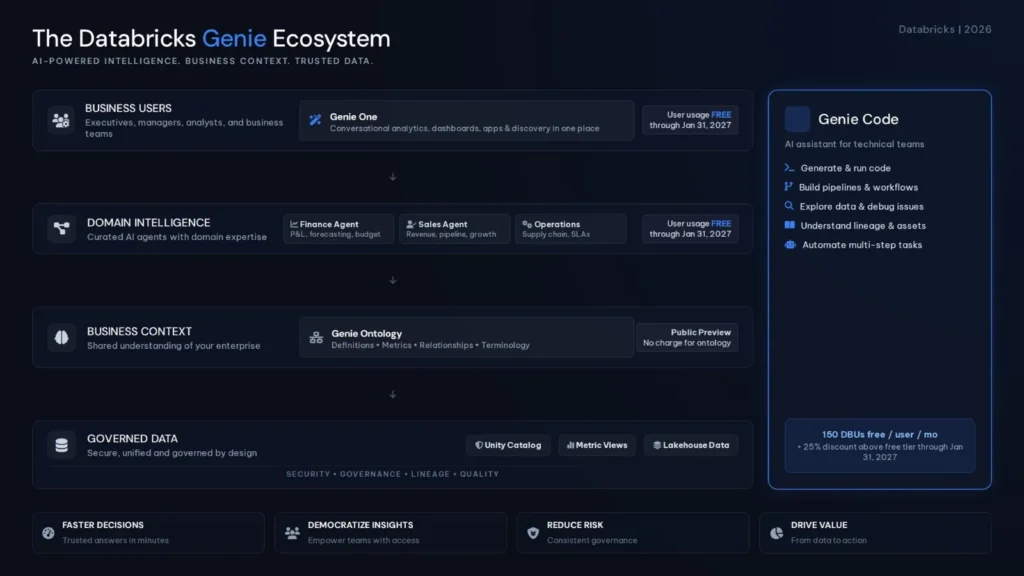
The Genie portfolio in one picture
A useful way to think about the new architecture is:
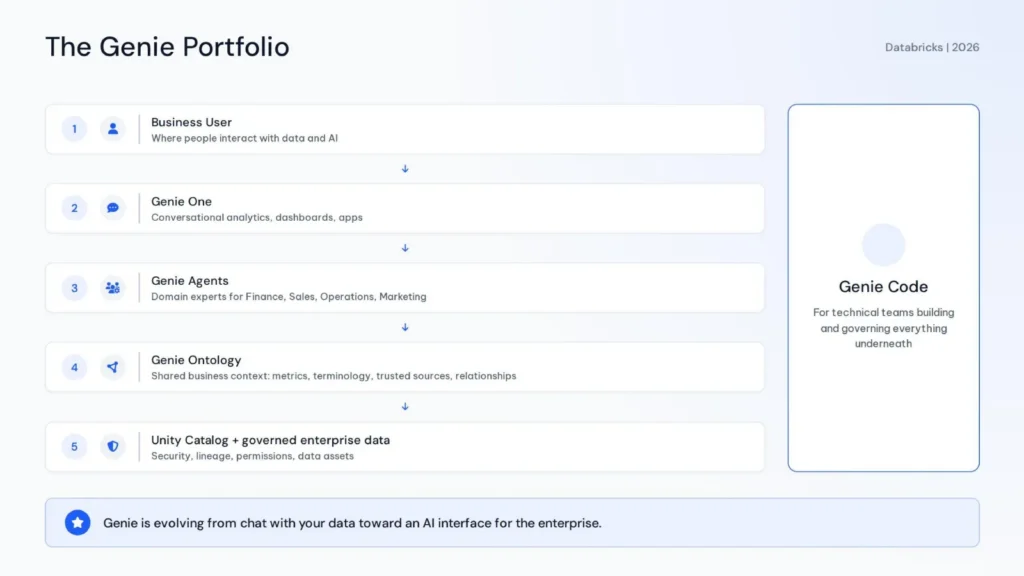
1. Genie One: the front door for business users
Best for: executives, finance teams, sales, marketing, operations and other non technical users.
Genie One is the simplest part of the portfolio to explain. It is designed to give business users one place to interact with company data without needing to understand notebooks, warehouses, SQL or the underlying Databricks architecture.
From Genie One, users can:
- ask questions in natural language;
- interact with AI/BI dashboards;
- discover shared data assets;
- access Databricks Apps;
- interact with configured Genie Agents.
Databricks has also introduced a Consumer Access entitlement specifically designed to give business users a simplified experience without giving them authoring capabilities inside the broader Databricks workspace.
Why business teams should care
The traditional BI experience starts with: “Which dashboard contains the answer?”
Conversational analytics starts with: “What do I want to know?”
That difference sounds small, but it fundamentally changes the user experience. A regional manager should not necessarily need to know that the answer lives in dashboard 17, tab 4, behind three filters.
They should be able to ask: “Why did margin decrease in the Northeast last month?”
Strengths
- Very low technical barrier to entry.
- Natural language interaction.
- Uses governed enterprise data.
- Can bring dashboards, applications and conversational analytics into one experience.
- Particularly valuable for organizations trying to expand data access beyond analysts.
Limitations
Genie One does not magically solve poor data foundations.
If an organization has duplicated KPIs, poorly documented datasets, contradictory business definitions, weak governance or unclear ownership, a conversational interface can simply expose those inconsistencies faster. AI does not eliminate the need for semantic governance. It makes it more visible.
2. Genie Agents: the domain specialists
This is where an important distinction appears. A company usually does not want one enormous AI assistant trying to understand the entire enterprise equally well. Finance has its terminology, sales has another, operations has different metrics. Healthcare, insurance and banking can have highly specialized definitions and governance requirements. That is where Genie Agents come in.
Formerly known as Genie Spaces, Genie Agents are curated analytical environments where data teams configure the datasets, example queries, instructions and business semantics that Genie should use for a particular domain.
A company could therefore have:
| Finance Genie Agent | Customer Genie Agent | Operations Genie Agent |
|---|---|---|
| P&L | Customers | Inventory |
| Revenue | Segmentation | Fulfillment |
| Forecast | Churn | SLAs |
| Budget | Lifetime value | Productivity |
| Margin | Engagement |
Instead of asking an unrestricted model to discover everything from scratch, the organization gives it a trusted analytical boundary.
Why this matters
The interesting enterprise AI challenge is not giving an AI access to more information. It is giving it access to the right information with the right context. Genie Agents allow data teams to curate that context.
Strengths
- Domain specific.
- Can be configured using trusted datasets and business instructions.
- Answers are SQL backed and governed.
- Can produce tables and visualizations.
- Reduces repetitive analyst requests.
- Can be exposed programmatically to other agents through Databricks managed MCP capabilities.
Databricks currently documents limits on the number of tables and views that can be attached to an Agent, reinforcing the idea that these should generally be focused business domains rather than giant enterprise wide semantic universes.
Limitations
Agents require curation, and that is not a weakness. It is actually part of the product’s value.
Someone still needs to determine:
- which datasets are authoritative;
- which metrics should be used;
- how terminology should be interpreted;
- what example queries represent correct business logic;
- which questions belong in which domain.
A poorly curated Agent will produce a poorer business experience.
3. Genie Ontology: potentially the most strategic piece
Here is where the story becomes much bigger than conversational BI.
Imagine asking: “How many active customers did we have last quarter?”
Technically, that appears simple, but what does active customer mean? A customer who logged in? Purchased? Had an active subscription? Generated revenue? Did any of those things during the last 30, 60 or 90 days? Humans inside the organization often know these rules implicitly. LLMs do not.
That gap is the enterprise context problem. Genie Ontology is Databricks’ attempt to address it.
Databricks describes Genie Ontology as a unified context layer that creates a business aware map of the organization. It combines governed semantic context from Unity Catalog with context inferred from existing enterprise assets, including:
- metric views,
- dashboards,
- SQL queries,
- Genie Agents,
- and other organizational artifacts.
The resulting context can identify things such as:
- Business definitions: “Active user means a distinct user deduplicated across platforms.”
- Authoritative sources: “Revenue questions should use the Finance Genie Agent.”
- Relationships: Customer → Subscription → Product → Revenue
This is critical because enterprise AI needs more than access to data. It needs to understand the relationships surrounding that data.
Why Ontology could matter more than the chatbot itself
There is a broader shift happening across enterprise AI: models are becoming commodities and context is becoming differentiation.
Most leading AI platforms can connect an LLM to a database.
Far fewer can answer:
- Which dataset should I trust?
- What does this KPI mean inside this company?
- Which calculation is officially approved?
- How does this entity relate to another business concept?
If Genie Ontology develops as Databricks intends, it becomes a layer that helps answer those questions once and reuse that understanding across multiple AI experiences.
Current limitation
Databricks enabled it by default in Genie One in August 2026, but companies should still treat it as an evolving capability rather than a mature semantic governance replacement. It should complement, not replace, good metric governance, quality metadata and strong Unity Catalog practices.
4. Genie Code: AI for the people building the data platform
Genie Code addresses a very different persona. Where Genie One focuses on consuming data, Genie Code focuses on building with it. It can help technical practitioners generate and run code, create pipelines, build dashboards, explore data, debug errors, work with notebooks and SQL, understand Unity Catalog assets and lineage, automate multi step development tasks and more.
Databricks now positions Genie Code as an AI coding and data assistant embedded throughout the workspace rather than simply a coding autocomplete tool.
The business case is clear: if Genie One reduces the friction between business users and data, Genie Code aims to reduce the friction between data practitioners and the platform.
Strengths
- Deeply integrated with Databricks.
- Context aware of catalog objects and lineage.
- Useful across engineering, analytics and data science workflows.
- Capable of multi step agentic tasks rather than simple code completion.
- Governed by the user’s existing Databricks permissions.
Limitations
It is not primarily designed for general business users, and AI generated code still needs engineering judgment. Databricks itself notes that certain automated execution capabilities, such as auto approve, are productivity features and not security boundaries.
So which Genie product is for whom?
| Capability | Genie One | Genie Agents | Genie Ontology | Genie Code |
|---|---|---|---|---|
| Primary user | Business user | Business and data teams | Entire organization | Technical teams |
| Main goal | Consume and interact | Trusted domain Q&A | Understand business context | Build and develop |
| Natural language Q&A | Yes | Yes | Powers context | Yes |
| Requires curation | Low | High | Governance plus automated inference | Low to Medium |
| Cross domain context | Yes | Domain specific | Across experiences | No |
| Writes or helps with code | No | No | No | Yes |
| Main business value | Democratize access | Trusted self service | Consistent meaning | Developer productivity |
| Maturity today | Production experience | Production experience | Public Preview | Production plus evolving agentic features |
The key is that these products are complementary rather than alternatives.
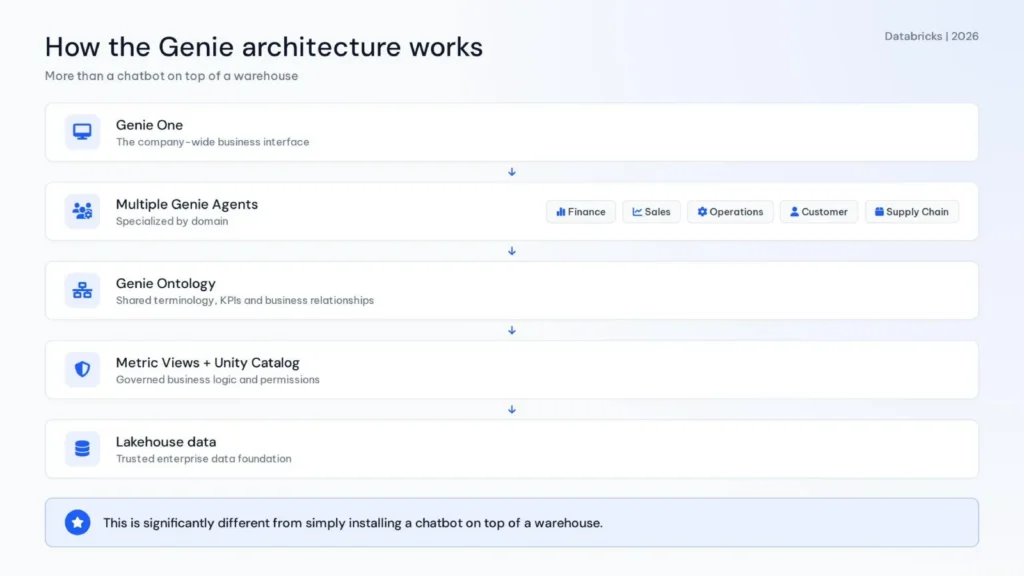
The most interesting architecture is not “one Genie”
For enterprise deployments, the architecture I would expect to become increasingly common looks more like this:
What does this mean for companies in the U.S. versus Latin America?
I would avoid saying that the U.S. is “advanced” and Latin America is “behind.” Enterprise AI maturity varies dramatically by organization, industry and company size in both regions.
But the commercial adoption patterns can be different.
U.S.: moving from AI experimentation toward enterprise distribution
In the U.S., many large organizations are already past the phase of asking:
“Should we experiment with Generative AI?”
The discussion is increasingly:
“How do we make AI useful across thousands of employees while controlling governance, cost and risk?”
Globally, McKinsey reported that 71% of surveyed organizations were regularly using generative AI in at least one business function, with adoption particularly concentrated in marketing and sales, product development, service operations, software engineering and IT. Larger companies were also using it across more parts of the organization.
For this market, Genie One and Ontology become particularly interesting because the problem is increasingly distribution and trust at scale.
The conversation shifts from AI pilot to enterprise AI operating model.
The U.S. business case will frequently emphasize:
- analyst productivity;
- employee productivity;
- reducing data request queues;
- governed self service;
- scaling across departments;
- agentic workflows;
- integration with existing enterprise applications;
- measurable ROI.
DIRECTV offers a useful example: Databricks reports hundreds of daily users querying a unified customer dataset containing more than 1,200 attributes through Genie powered experiences.
That is no longer a technology demo. It is an adoption problem.
Latin America: the business case often needs to be more immediate
Across Latin America, there is substantial AI adoption and experimentation, but budget discipline and demonstrable value can play an even larger role in technology decisions.
Research from IDC’s Latin America practice has reported significant GenAI investment while also highlighting concerns about data quality and the reliability of AI outputs.
For Genie, this can actually create a compelling entry point.
Instead of starting with:
“We need an enterprise AI platform.”
A stronger conversation may be:
“Which recurring business question currently takes two days to answer?”
or:
“Where are analysts spending hours generating information someone else could safely retrieve themselves?”
That leads to much more tangible cases:
- Finance: “Explain this month’s budget variance.”
- Commercial: “Which customers reduced purchases compared with the previous quarter?”
- Operations: “Which locations are consistently missing their SLA?”
- Executive management: “What changed since last week’s performance review?”
The value proposition becomes less about AI itself and more about faster access to trusted decisions.
Latin America may also expose the value of Ontology faster
There is another interesting factor. Large Latin American organizations frequently operate across countries, business units, multiple ERP implementations, acquisitions, Spanish and Portuguese terminology, and local definitions of global KPIs.
Consider something as simple as customer, client, active client and active account. These may refer to similar, but not necessarily identical, concepts. That makes semantic alignment particularly valuable.
Genie Ontology therefore has a potentially powerful LATAM story: not only translating language, but translating the organization itself.
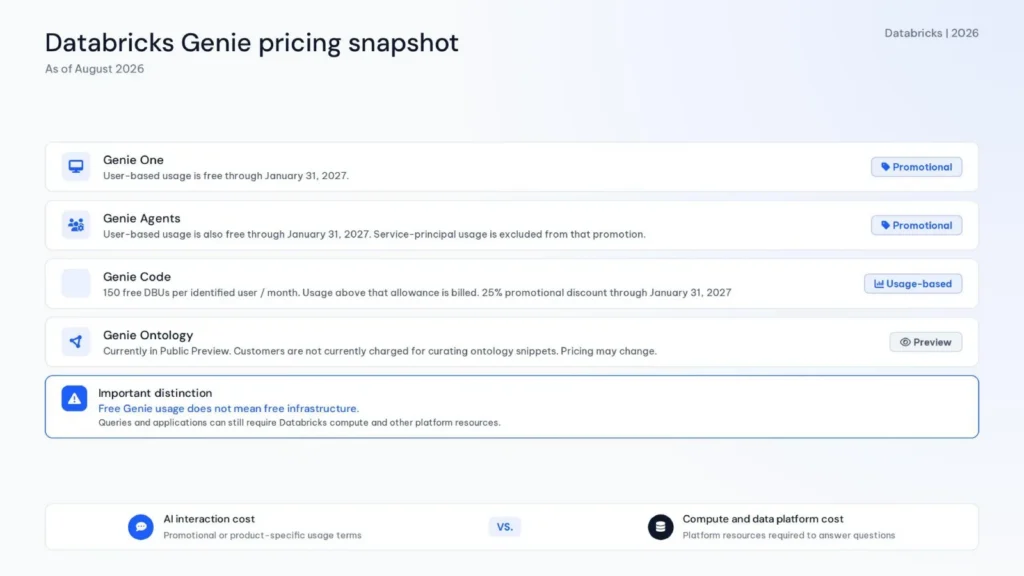
Pricing: “free” needs an asterisk
There is currently a strong promotional window for organizations evaluating Genie. According to Databricks, free usage applies to Genie LLM usage only, while the compute Genie relies on, such as SQL Serverless, is billed separately.
The biggest limitation is not the LLM
When companies evaluate conversational analytics, the conversation often starts with model accuracy. Of course that matters, but in practice, the most difficult implementation questions are usually:
- Do we have trusted metrics?
- Do we know which datasets are authoritative?
- Is our metadata meaningful?
- Are permissions correctly configured?
- Can different departments agree on business definitions?
- Who owns the Agent after launch?
These are not AI questions. They are data operating model questions.
And that may be the strongest aspect of Databricks’ current direction. Unity Catalog governs the assets. Metric Views can define reusable metrics. Genie Agents provide domain level analytical context. Ontology connects those concepts into a broader organizational understanding. Genie One exposes it to business users. Genie Code helps technical teams build and maintain it. The pieces increasingly reinforce each other.
The real opportunity: from dashboards to conversations to action
Dashboards are not disappearing.
They remain excellent for questions we already know people will ask.
“What is revenue?”
“What is our conversion rate?”
“How are we performing versus target?”
But businesses also constantly ask questions nobody anticipated when the dashboard was built.
“Why did it change?”
“Which customers caused it?”
“Is the same pattern happening elsewhere?”
“What should I investigate next?”
That is where conversational analytics becomes powerful.
And the next evolution goes even further.
Not simply:
Ask → Answer
but:
Ask → Understand → Analyze → Act
That could mean asking Genie why a KPI changed, opening the relevant application, initiating a workflow or assigning the next action, all while respecting the same governance model.
That is a much bigger vision than conversational BI.
My takeaway
The most important development in Databricks Genie is not that business users can talk to their data. We have had natural language to SQL products for some time. The more important development is that Databricks is assembling the layers required for AI to understand the business context around the data.
Genie One provides the experience. Genie Agents provide specialized expertise. Genie Code accelerates the teams building the platform. And Genie Ontology attempts to provide something enterprise AI desperately needs:
shared organizational context.
For companies evaluating Genie, I would therefore avoid starting with:
“Where can we deploy an AI chatbot?”
Start instead with:
“Which business decisions are currently slowed down because people cannot easily access trusted data?”
Build one well governed domain around that problem.
Define the metrics.
Curate the context.
Measure adoption.
Then expand.
Because the long term opportunity is not giving everyone another AI tool.
It is giving everyone access to the same trusted understanding of the business.