













When I started my career as a Journalist, I firmly believed that my readers wanted and valued high-quality, verified information in the articles they consumed. In time, and after pivoting my professional profile into Technical Writing, I realized that my readers today have a much higher appreciation for carefully structured, well-written knowledge bases created methodically and properly sourced.
The ideals at the backbone of my initial interest in Journalism haven’t changed: it’s the commercial landscape that has created an environment that rewards attention-grabbing headlines, sensationalism, and velocity over a commitment with seeking something that is as close as possible to the truth.
Years went by and I moved away from Journalism, choosing software Technical Writing as my profession. I discovered that there’s an ever increasing need for reliable internal- and external-facing knowledge bases to help Product, Success, and Implementation teams understand what their product is capable of doing, its limitations, and its configurations. Customer-facing teams need fact-checked articles that empower them to provide clients with actionable information.
“There’s an ever increasing need for reliable internal- and external-facing knowledge bases to help Product, Success, and Implementation teams understand what their product is capable of doing.”
Users need carefully crafted in-platform Help sections that allow them to quickly answer questions by themselves and kickstart their platform usage experience. Integrations teams need a bridge that connects their work with external-facing teams helping assisting clients develop, configureing, and useing integrations with their product. But maybe the most important aspect of my work today is creating and maintaining machine-readable knowledge bases for AI tools to retrieve information from and help internal and external users quickly and accurately answer product-related questions.
The Problem of Documentation Debt
Fast-growing software companies incur huge documentation debt as their product becomes larger and their customer bases wider. Information becomes siloed in a few individuals and teams who don’t have the time to create product documentation to close the gaps created by that fast growth. Teams become disconnected, Slack channels cluttered with the same repeated questions, support teams drowned in tickets that address the same thing over and over again, Product Managers are swamped by internal and external information requirements. These gaps get worse with each minor release, and much worse with each major one.
“Information becomes siloed in a few individuals and teams who don’t have the time to create product documentation.”
Technical Writers and Knowledge Managers are more important than ever before to act as builders creating roads and bridges connecting these silos, crafting verified sources of truth accessible by the whole organization, adapting documentation to cater to different audiences, internal and external, technical and non-technical; feeding LLMs with the information they require to do what they do best in these cases: make information accessible, providing context-rich solutions.
But the riches provided by good documentation don’t stop there: new-joiners and fresh team members can leverage it to kickstart their journeys which would be otherwise stymied by lack of sources of truth, swamped product owners, and unavailable referents.
Lack of Documentation Prevents Growth and AI Enablement
I think that the accrued documentation debt that I see in so many organizations, postponed for growth, actually prevents growth and disables their capacity to leverage AI to democratize information and help their end-users. I believe that good Technical Writing and Knowledge Management teams are the gateway to meaningful applications of AI in basically any software company out there. If you don’t know what you know about your product, LLMs won’t either.
“If you don’t know what you know about your product, LLMs won’t either.”
The teams I work with value the importance of accurate documentation, of translating hard concepts into agnostic sources of truth that are easy to read and understand. They see the value of documentation in their day to day interactions with teams and customers: questions are answered promptly, implementation teams have verified documentation available for their workflows, success teams can help customers faster and more effectively, knowledge is readily accessible, reviewed, and reliable.

Best Practices for Documentation in the Age of AI
Creating high quality, useful documentation requires a repeatable process that keeps information accurate, consistent, and easy to maintain as products evolve.
In my experience, the most successful documentation teams share a few common practices:
- Discover efficiently by reviewing existing documentation, repositories, support tickets, and product discussions before writing. GenAI tools can be highly valuable at this stage.
- Use standardized templates to create consistency across products, audiences, and documentation types.
- Document continuously, treating documentation as part of the product lifecycle rather than an afterthought.
- Apply AI where it adds value, using it to speed up discovery, drafting, and maintenance while relying on Technical Writers for review, validation, and editorial decisions.
- Review and validate every article with Technical Writers and subject matter experts to ensure clarity and accuracy.
- Establish ownership so documentation is regularly maintained, reviewed, and updated as the product evolves.
Modern AI tools make documentation teams more efficient, but they don’t replace the need for well-defined processes or experienced Technical Writers. Reliable documentation still depends on accuracy, structure, and careful review.
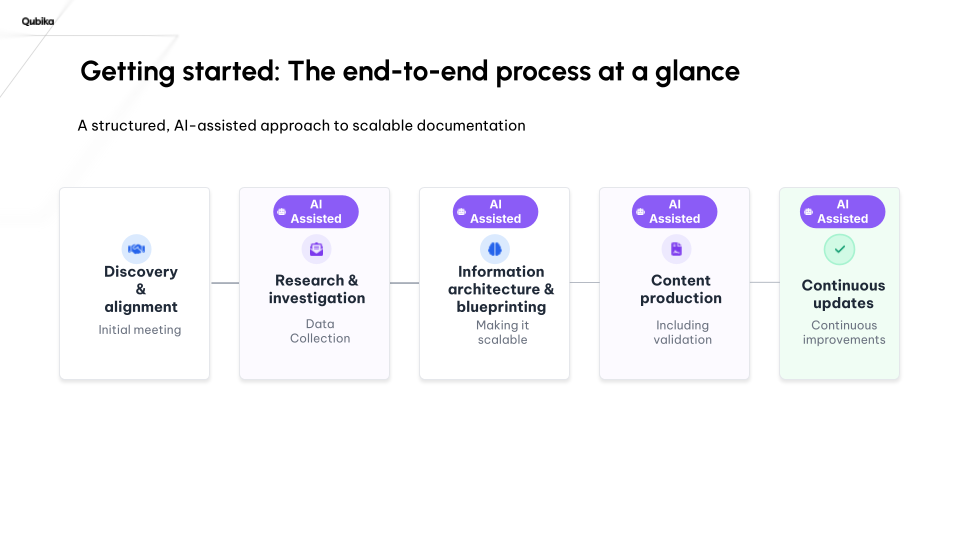
Below you can see the end-to-end process that the technical writing teams use at Qubika:
Final Thoughts
So, in truth, those qualities I valued from my years as a Journalism student I find today as a core aspect of my job as a Technical Writer, especially with the advent and general adoption of AI. As organizations increasingly embrace AI, those principles have become more important than ever. Reliable technology starts with reliable information, and reliable information starts with good Knowledge Management.