







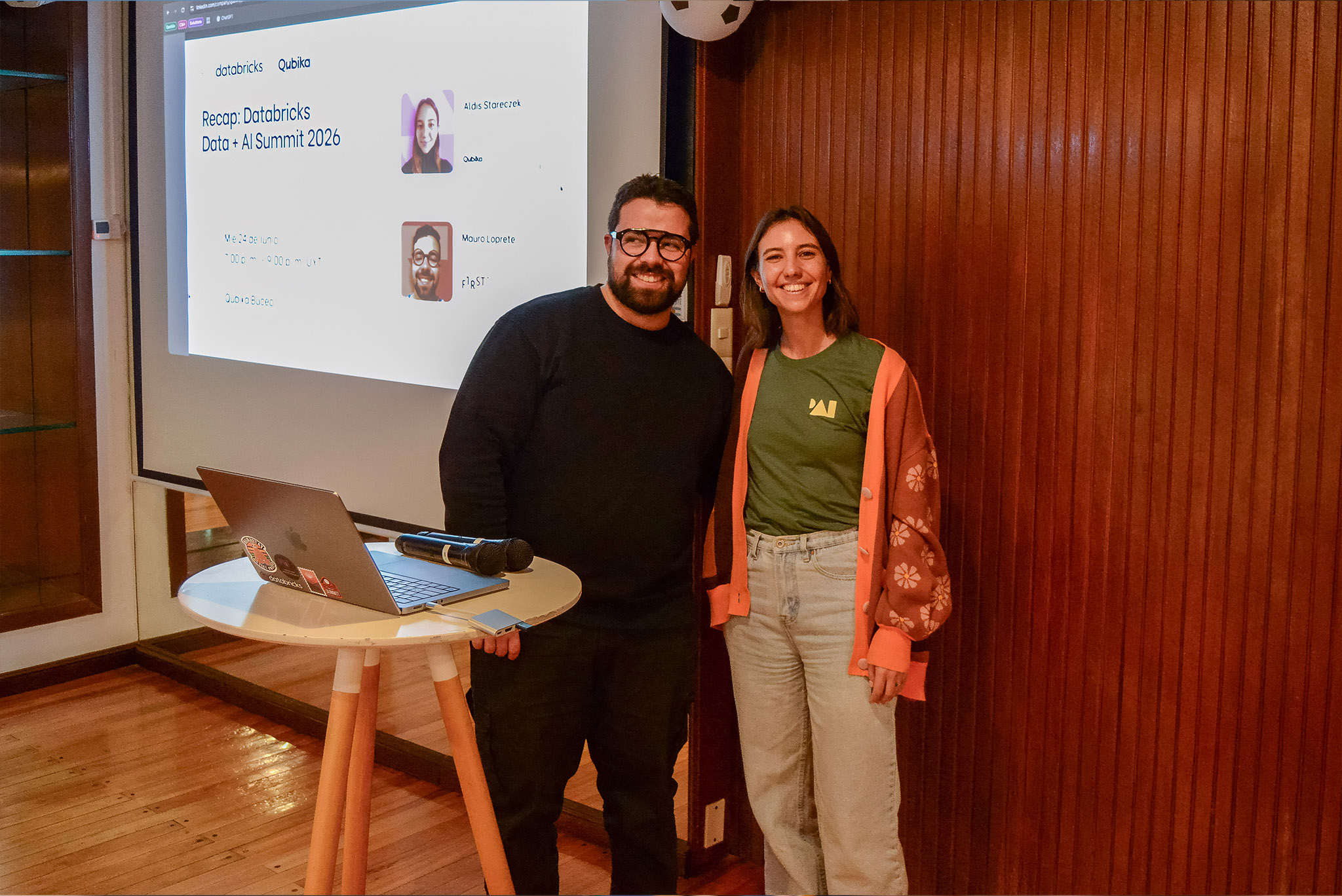
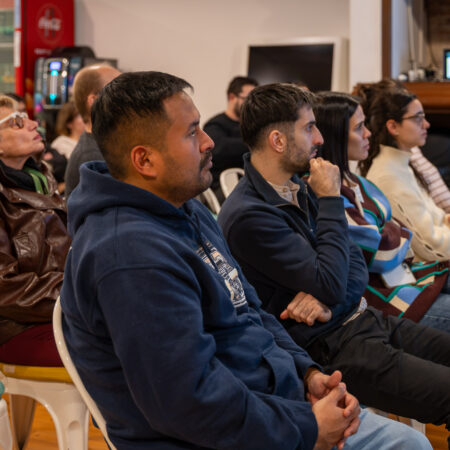
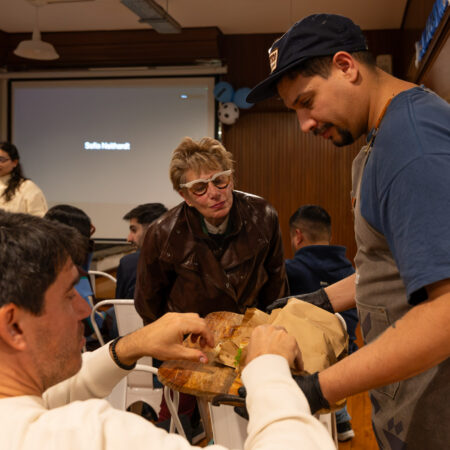
Last night, with the fireplace lit and homemade focaccia coming out of the kitchen, our community gathered again for another Databricks Meetup Montevideo. The format was simple and the room was full: two talks, fresh learnings, and an honest conversation about what is real and what is still maturing in the Databricks platform.
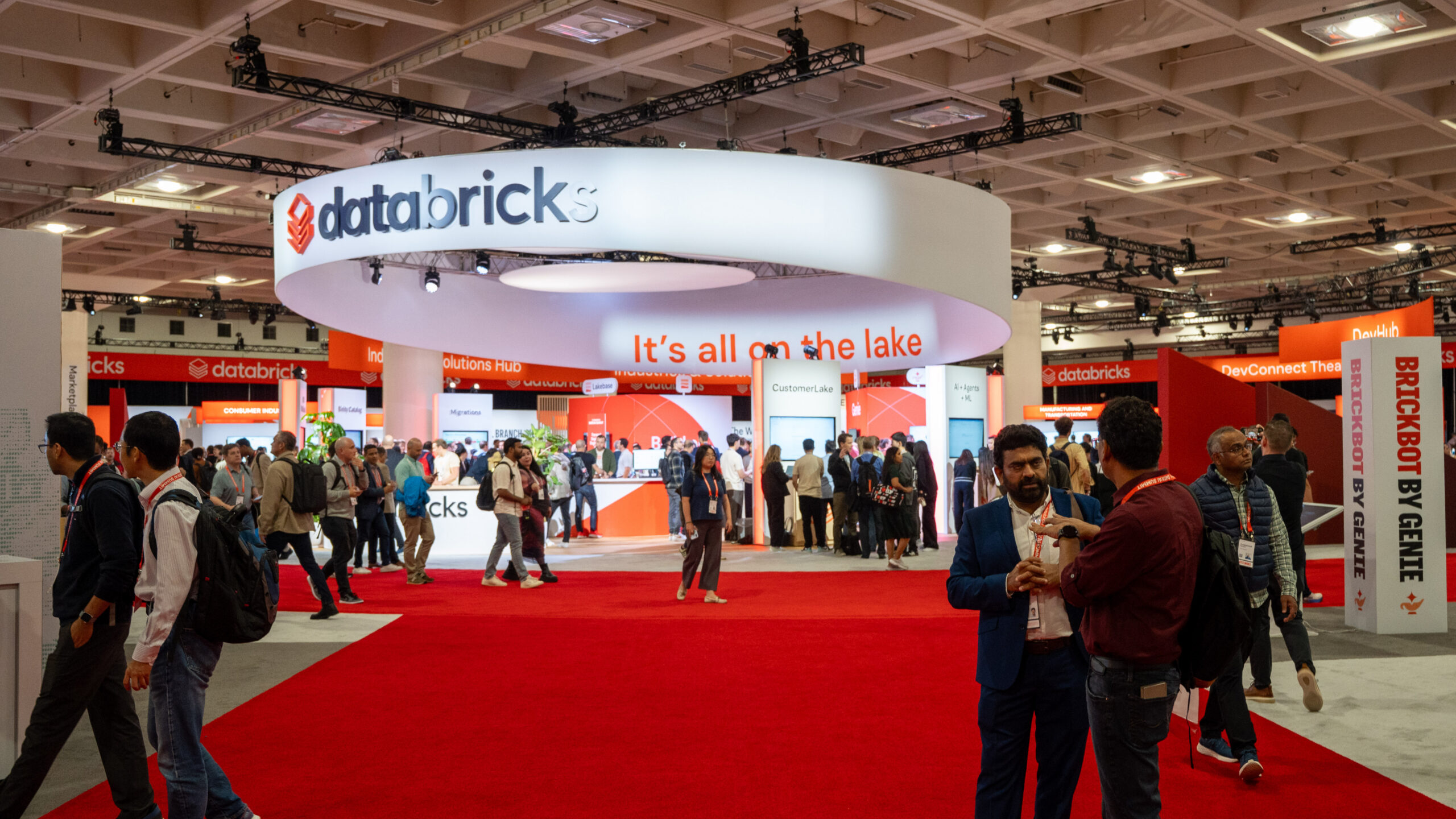
Qubika attended the Databricks Data + AI Summit 2026 in San Francisco for the third year in a row, this time with a booth, a technical session, and presence on the official agenda. The Summit ran June 15 to 18 at Moscone Center and drew more than 30,000 people in person across three buildings, with 800 plus breakout sessions, hands-on labs, and a multi-day hackathon. This year we also attended as a Databricks Gold Partner, now part of the top tier of the partner ecosystem, which says a lot about the depth our teams have built around the lakehouse.
This post is the recap of both meetup talks. The first translated the Summit announcements into concrete decisions. The second went deep on one of the hardest problems teams face once they have a working agent: how to take it to production in a scalable, governed way. For the full list of releases, see our companion piece, everything Databricks announced at DAIS 2026.
The strategic thread: context, choice, and control
Before listing features, it helps to ask why Databricks keeps investing the way it does. The message from the keynotes was direct. Agents are everywhere now, and almost anyone can build one. The hard part is no longer building an agent — it is making sure that agent has the right business context, that it acts under governance, and that teams keep the choice of which model and framework sit behind it.
That gives us a clean way to organize everything announced at the Summit into three blocks: context, choice, and control. Most of the new capabilities map onto one of them, with a transversal infrastructure layer underneath, mostly around Lakebase, the transactional database Databricks has been pushing since last year.
A practical note before going further. Each announcement sits at a different maturity stage. Generally Available features can be used in production today. Public Preview can be tested but is not recommended for production systems. Beta is still iterating and likely to change. Private Preview is invitation only. Keeping that map in mind is the difference between a smart bet and a painful surprise.
Talk 1: Summit recap, translated into decisions
Speaker: Aldis Stareczek, Solutions Architect and Databricks Champion at Qubika.
Genie: giving agents real business context
The most important block this year was Genie, now a family of five products. The headline is Genie Ontology, which Aldis described as the brain behind the rest. It is a live, self-improving knowledge graph that continuously maps your company’s data, pipelines, queries, dashboards, and connected apps, then feeds that context to every Genie product. This is not a configuration you set up — it builds automatically from day one.
It builds context in two ways. The automatic path is already running. It weighs signals such as how often a dashboard or query is used, where the data comes from, and who created it. A metric defined by the CFO carries more weight than one from an unverified source, and a dashboard untouched for three months counts for less than a query run every day. When you talk to Genie, you can click into the reasoning and see exactly what context it used and why. In an internal Databricks benchmark, Genie with the Ontology answered 84.5% of questions correctly on the first attempt, compared to 52.4% for the strongest general-purpose coding agent — and it was twice as fast.
The manual path is where humans encode what only they know, through Unity Catalog Semantics, which ships three modules: a Business Glossary (Preview soon) for authoritative definitions, Domains (Public Preview) to organize assets by business area, and Metrics (GA) to define KPIs once as governed objects reusable across dashboards, agents, and apps. Manual rules outweigh automatic inference by design. The more rules you add, the more contextual and accurate your agents become.
The rest of the Genie family rounds out the story. Genie Agents — formerly Genie Spaces, which already has over 1.5 million instances created — can now reason and act through MCP connections and scheduled tasks, read unstructured files such as PDFs and contracts, and scope its expertise by domain. The upgrade path for existing Genie Spaces is straightforward: the core remains the same, the new capabilities layer on top. Genie One is the business user front end, now available on mobile and integrated natively with Slack and Teams, so a non-technical user can ask a question inside a channel and get the answer back without ever opening a workspace. Genie Code keeps getting more robust, including the ability to migrate Power BI, Looker, and Tableau visualizations into Databricks. And Genie ZeroOps — still in Private Preview — points toward an agent that monitors production workloads autonomously, runs root cause analysis through Unity Catalog lineage, and proposes fixes without human intervention.
Lakebase: unifying transactional and analytical data
Lakebase, the transactional database built on the Neon acquisition, is getting a strong push to become more robust and more attractive for application back ends built directly on Databricks. The direction is clear: unify analytical and transactional data through the LTAP architecture (Lake Transactional/Analytical Processing, coming soon), add vector and full-text search to capture data more easily via Lakebase Search (Beta), and pull more application workloads onto the platform. Expect several iterations through the year. Useful to watch, still maturing in parts.
Agent Bricks, Unity AI Gateway, and Omnigent: choice and control
Agent Bricks remains the platform where developers build agents — distinct from Genie Agents, which is designed for business users and domain experts. The emphasis this year was choice. When Anthropic released a new model, Databricks made it available for agents within a day. You can bring your preferred orchestration framework — LangGraph, CrewAI, Claude Code SDK, OpenAI Agents SDK — and Databricks added managed agent memory through Lakebase and MCP-based tool access. The platform now processes over one quadrillion tokens per year across 100,000 plus agents in production.
Two governance pieces stand out. Unity AI Gateway is generally available and already in use across several Qubika clients. It is the control and governance layer for the agents, models, and MCPs in play — with hard spend caps, smart routing, contextual policies, and built-in guardrails for PII and prompt injection.
Omnigent — announced just days before the Summit by Matei Zaharia, Databricks CTO and co-creator of Apache Spark — is an open-source meta-harness (Apache 2.0) that sits on top of orchestration frameworks. A meta-harness is not a replacement for LangGraph or CrewAI — it is a layer above them. The analogy is straightforward: if orchestration frameworks are the engines of different cars, Omnigent is the centralized dashboard that lets you start, monitor, and stop any engine from one place, regardless of make or model. A company running LangGraph in one department and the Claude Code SDK in another can switch orchestrators without rewriting code, while routing everything through Unity AI Gateway. The room liked it for being framework-agnostic and built for scale. A managed version on Databricks is available in Beta, but it is one to follow closely rather than adopt in production today.
Apps, Marketplace, and OpenSharing
Databricks wants teams to keep building apps with their data, now with centralized governance through App Spaces and a new Serverless Micro Apps runtime that spins apps down when nobody is using them, so you stop paying for idle compute. The app builder is powered by Genie Code — the same tool data engineers already use — now with native awareness of your Unity Catalog assets and data. Apps can also be published to the Marketplace, letting clients adopt them into their own workspace without sharing source code, and customers can pay using their existing Databricks universal commit, removing the need for a separate procurement process.
On the sharing side, OpenSharing evolves Delta Sharing into the agentic era. Beyond structured data, you can now share AI assets — agent skills, models, and Genie Agents — via the same open protocol, now hosted under the Linux Foundation. Three infrastructure improvements accompany the launch: Iceberg Interoperability opens sharing to any platform supporting the format, including Snowflake, which is the headline — Snowflake implemented inbound OpenSharing support, making it the only protocol you need to share data with any client on any cloud using any tool, including your main competitor’s platform. SecureConnect removes the need to configure a network connection per recipient through a one-time proxy setup. And Global Distribution means cross-region sharing no longer carries the usual egress costs. On-premises storage partners including NetApp, MinIO, Qumulo, VAST, HPE, Nutanix, and Cohesity now implement the protocol natively, which matters for regulated industries where data cannot move to the cloud.
Security: LakeWatch and the Panther acquisition
With so much focus on building agents, the obvious question is how to keep everything protected. Agents multiply the attack surface — more autonomous actions, more connected systems, more speed, less human oversight. Databricks answered with LakeWatch, its security lakehouse that unifies security, IT, and business data for agentic detection and response. Unlike traditional SIEMs, LakeWatch understands the lakehouse context: it knows which table an agent touched, which model it used, and what it returned, by consuming traces from Unity AI Gateway directly. Databricks reported up to 80% lower TCO compared to traditional SIEM platforms. During the Summit, Databricks announced the acquisition of Panther — founded by the team behind StreamAlert, the open-source security platform originally built at Airbnb — bringing 100-plus out-of-the-box integrations and detection as code. LakeWatch is in Private Preview, with Adobe and Dropbox among the early customers. This is the agentic security category taking shape, still early but clearly strategic.


Talk 2: From YAML to production, deploying AI agents with DABs
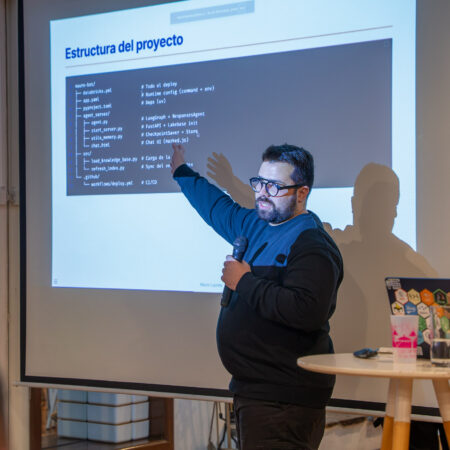
Guest speaker: Mauro Loprete, Data Engineer at F1RST (Grupo Santander) and Databricks Certified Data Engineer Professional.
Your agent works in a notebook. Now what? Taking it to production means orchestrating serving endpoints, vector search, jobs, permissions, monitoring, and per-environment deployments. Mauro walked through how to manage that whole lifecycle declaratively.
The tool is Declarative Automation Bundles (DABs), recently renamed from Databricks Asset Bundles. You declare jobs, notebooks, resources, and infrastructure in YAML, work in a development environment with version control such as Git, and promote to staging and production through CI/CD using the same tool end to end. The rename is non-breaking — all existing commands still work — and a few new ones were added.
The most important recommendation: migrate to the new Direct Deployment Engine. The old engine translated everything to Terraform, which made errors hard to read because they referenced Terraform code rather than your bundle. The Direct Deployment Engine, now generally available, removes that layer, and some features such as Unity AI Gateway configuration only work in this mode. There is a single migration command, databricks bundle deployment migrate, and in Mauro’s experience the migration broke a few things but took about thirty minutes to fix, not an afternoon.
Two more quality-of-life wins. bundle plan gives you a clear summary of what will be created or updated before you deploy, which is invaluable inside a pull request. And Python bundles are now generally available, so teams that already know Python can define resources dynamically — for example generating one job per item produced by an upstream process.
Mauro grounded all of this in a real case: a RAG agent with memory, deployed end to end. The agent scrapes his blog into a Delta table, keeps a vector search index in sync through change data feed, answers questions, and stores conversation checkpoints in Lakebase. The whole project — app, database, endpoints, and a scheduled scraping job — is declared in YAML and shipped through GitHub Actions, with the pull request running validate and plan, a human reviewing the diff, and a deploy on merge to main. No clicking through the interface.
The most memorable part was the Unity AI Gateway v2 guardrails demo. He recalled the McDonald’s ordering bot that happily wrote Python to reverse a nested list alongside the nuggets order — the classic case of a public agent being used for something it was never meant to do. With the older AI Gateway, you defended against that with system prompts alone. The v2 adds a model that audits responses and can block prompt injection, hallucinations, or off-topic use. In the live demo, the protected app refused a prompt injection attempt cleanly, while the unprotected one happily handed over a cheesecake recipe. A simple, honest reminder that the tools are powerful, and that putting an agent in front of the public without guardrails is asking for trouble.
His closing advice is worth repeating: keep bundles small — one per domain or project rather than one mega bundle. Migrate to the Direct Deployment Engine because every new feature lands there first. Use uv instead of pip for faster dependency installs. Lean on bundle plan as your best friend. And if your agent only deploys with manual clicks, something in your setup is wrong.
What is ready, and what still needs caution
The honest read from both talks: generally available capabilities like Unity AI Gateway, Genie Code, the Direct Deployment Engine, and Python bundles are ready for production work today. Genie Ontology and Unity Catalog Semantics — particularly Metrics, which is GA — are the most strategically interesting bets for teams that want trustworthy agents, with parts already live and others in preview. Lakebase, Genie ZeroOps, Omnigent, and LakeWatch are promising but still maturing: worth piloting rather than betting the roadmap on. As always, check the maturity stage before you commit.
Where Qubika fits
Modernizing a data platform and putting AI agents into production are two different challenges, and both are squarely in Qubika’s wheelhouse. As a Databricks Gold Partner with more than 200 Databricks certified professionals, our teams work daily on lakehouse architectures, Unity Catalog governance, lakehouse migrations, and agentic workflows in regulated and real-time environments.
If your team is evaluating a migration to Databricks, or trying to move agents from notebook to production with the right governance, connect with our team to talk through your next step.
FAQ
What was the main theme of the Databricks Data + AI Summit 2026? Context, choice, and control. Databricks focused on giving agents the right business context through Genie Ontology and Unity Catalog Semantics, giving teams the freedom to choose models and frameworks through Agent Bricks and Omnigent, and keeping everything governed through Unity AI Gateway and LakeWatch.
What is Genie Ontology? A live context layer that continuously maps a company’s data, dashboards, queries, and connected apps into a knowledge graph, enriched manually through Unity Catalog Semantics, so Genie answers business questions accurately. In an internal benchmark it answered 84.5% of questions correctly on the first attempt.
What is the difference between Genie Agents and Agent Bricks? Genie Agents is designed for business users and domain experts — created with a prompt, no code required. Agent Bricks is the developer platform for building any type of agent with full control over model, framework, memory, and tooling. They are complementary: an agent built with Agent Bricks can be exposed as a tool inside a Genie Agent.
What is Omnigent? An open-source meta-harness (Apache 2.0) created by Databricks CTO Matei Zaharia. It sits above orchestration frameworks like LangGraph or CrewAI, letting teams switch between them without rewriting code, while routing governance through Unity AI Gateway. Think of it as the centralized dashboard above the engines, not a replacement for the engines themselves.
Why is Snowflake supporting OpenSharing significant? Databricks and Snowflake are direct competitors. Snowflake implementing inbound OpenSharing support means the protocol transcends the Databricks ecosystem — it is now the single protocol you need to share data or AI assets with any client on any cloud using any tool, including your main competitor’s platform.
What changed with Databricks Asset Bundles? They were renamed to Declarative Automation Bundles. Commands still work, the new Direct Deployment Engine replaces the Terraform-based engine, and Python bundles are now generally available.
Which features are safe to use in production right now? Generally available ones, including Unity AI Gateway, Metrics in Unity Catalog Semantics, Genie Code, the Direct Deployment Engine, and Python bundles. Preview and Beta features such as parts of Lakebase, Genie ZeroOps, Omnigent, and LakeWatch should be piloted with caution.
Related reading
- Everything Databricks announced at the DAIS Data + AI Summit 2026
- Databricks App Spaces and the Genie App Builder at Summit 2026
- Open Sharing and shareable Genie agents at Databricks Summit 2026