









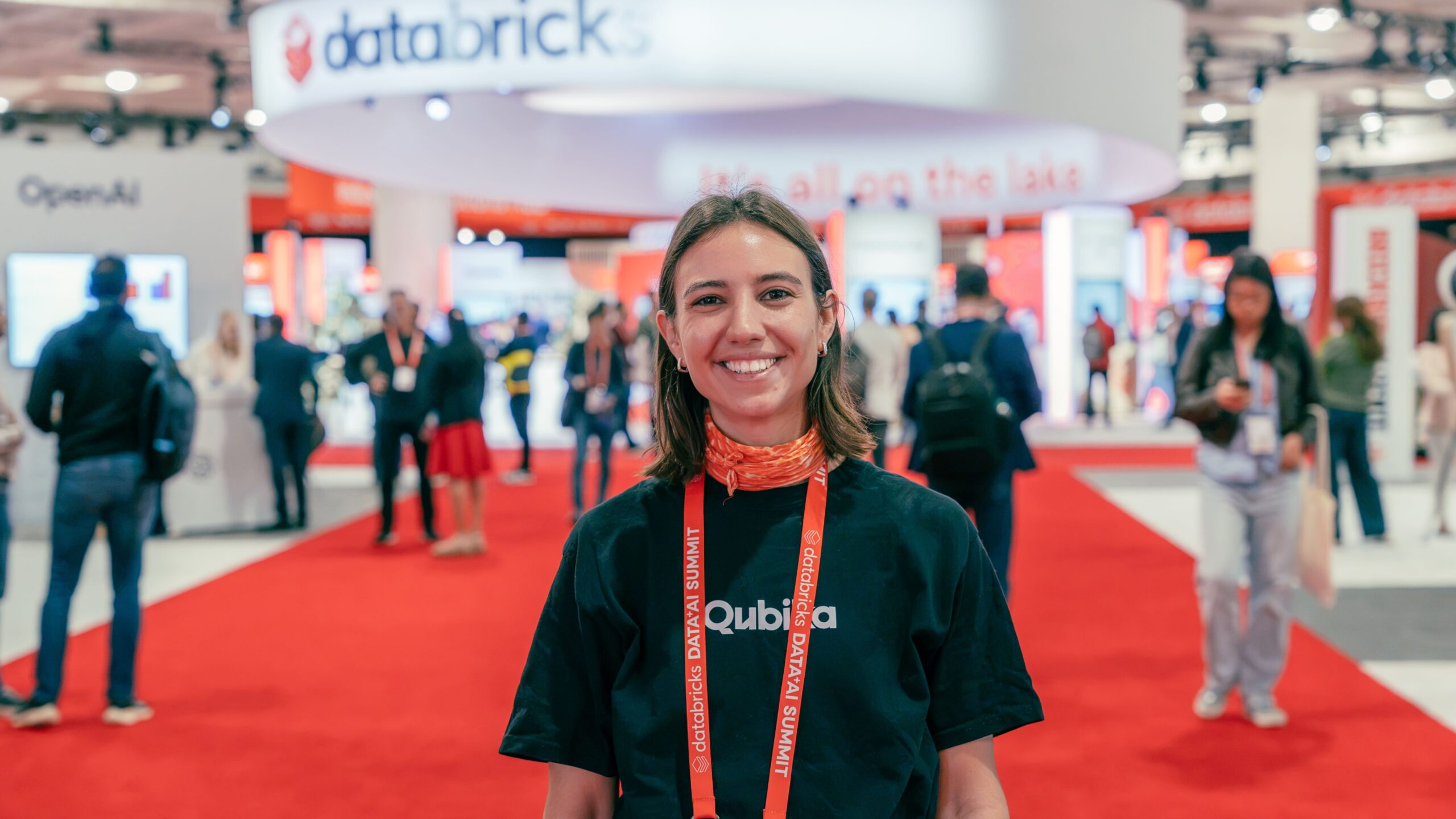
A few weeks ago, in mid-June, I had the chance to attend the Data+AI Summit in San Francisco, representing Qubika. Between all the technical sessions, one panel has stuck with me ever since: “Women in Data + AI,” moderated by Robin Sutara (Databricks), with Jaya Upadhyay (Zillow), Caroline Peika (Rady Children’s Hospital), and Kristy Mayer-Mejia (Kraken Technologies) as panelists.
It wasn’t a talk about “how to be a woman in tech.” It was four leaders with decades of experience talking about platform strategy, data trust, and running global teams, and along the way, they also talked about gender. That combination is exactly what made it worth writing about.
Modernization is never really a technology problem
Before getting to the leadership questions, the panel spent a lot of time on something every one of us in consulting recognizes instantly: migrations and platform modernizations rarely fail because of the technology. Jaya talked about resisting the urge to justify a platform migration with vanity metrics “we migrated 10,000 tables”, and instead tying it to a real business outcome: are you moving faster, can you access data you couldn’t before, is the business actually advancing? Caroline told a similar story from healthcare: modernizing Rady Children’s data platform wasn’t a technical hurdle, it was a trust hurdle. Different teams had built different dashboards with different numbers, and people had quietly stopped believing in the data. The fix wasn’t locking everything down, it was formalizing informal data stewards, giving people better tools, and rebuilding a sense of shared ownership.
Kristy took the business framing even further, describing how Kraken Technologies, which runs the operating system behind utilities’ customer and payment operations, turns data quality itself into a commercial asset. The data they produce for clients is clean and consistent in a way she said she hadn’t seen elsewhere in her career, and the company’s belief is that this data belongs to the client, not to Kraken. That single principle, she said, is what actually unlocks transformation: it’s not the software that makes a client data-driven, it’s trusting them enough to hand over data they can build on. A lot of her job, in practice, is storytelling internally about that value, and since the data is shared externally being just as deliberate about security and governance, so clients trust not only the quality of what they’re getting, but that it’s genuinely protected.
That theme, technology as an enabler, trust and adoption as the real currency is one I see constantly in our own client work, and it was refreshing to hear it validated by people running it at this scale.
There was also a very practical moment during Q&A, when someone from the World Bank asked how to get executive sponsorship for a foundational data effort when the exciting part (the AI use cases) is still down the road. Caroline’s answer was refreshingly blunt: tie the unglamorous foundation work directly to the specific, exciting projects the business already wants and can’t have yet, you don’t get the fun stuff until the foundation underneath it actually works. Kristy suggested running a small pilot first and extrapolating its results outward, rather than asking for buy-in on faith alone. And Jaya offered a third lever that’s especially relevant right now: in regulated industries, show leadership that not modernizing is the bigger risk, because AI regulation is evolving faster than most legacy platforms can keep up with.
Building for agents, not just for people
One audience question pushed the conversation somewhere I didn’t expect: how do you design data infrastructure for AI agents, when everything we’ve built so far was designed for human analysts? Jaya’s answer was: agents don’t have the luxury humans have of walking over to someone’s desk and asking what a field actually means. An agent will simply assume, and it might assume wrong. Her advice was to treat every agent like a new intern: define your core business concepts explicitly, document where they live, and don’t expect the agent to infer meaning your own company has never agreed on. Does “listing” mean a property for sale or a rental? If your organization can’t answer that consistently, no agent will either.
Kristy pointed out that this isn’t really a new problem, ambiguous field definitions have plagued every data team forever, they were just quietly tolerated because a human was always around to ask. Jaya added a line she credited to a recent Anthropic paper on this exact topic: unlike general software engineering, where there are often multiple valid ways to build something, data usually has only one correct answer, which is exactly why a single, governed source of truth matters more, not less, in a world where agents are the ones querying it.
On being heard in rooms built for someone else
The question from the audience that stayed with me most was simple: how do you make yourself heard in leadership rooms still mostly occupied by men? The three answers weren’t a rulebook, they were three different ways of planting a flag.
Caroline talked about authenticity. She remembered being one of ten women among three hundred men in her computer science classes, and said the lesson she carries is not to try to sound like the men in the room, but to build value that speaks for itself, regardless of who’s evaluating it.
Jaya’s version was less about a technique and more about a mindset shift. Early on, she got informal feedback that read as a criticism of how she showed up in meetings, too forceful, too much. Rather than internalizing it or quietly toning herself down, she went and had an honest, low-stakes conversation about it, and came out the other side realizing that what had been labeled a flaw was really just clarity and conviction. Since then, she’s stopped treating that energy as something to apologize for. She leans into it and owns it as part of how she leads.
Kristy’s version hit close to home for anyone who’s ever felt talked over in a technical meeting. Early in her career, she’d show up with all the details, only to watch someone else, often a man, summarize her work in a simpler way and get heard for it. Instead of resenting that, she got deliberately good at synthesis: finding the headline, without losing the substance underneath.
Caroline made a related point earlier in the panel, about the mechanics of that same skill across the different industries she’s worked in (gaming and healthcare). Talking to game designers about player experience calls for a completely different vocabulary and set of priorities than talking to clinicians about patient outcomes. She’s not a doctor, so with clinical audiences she deliberately dials down the technical detail and leans into the human story: the patient journey, the impact on care. The skill isn’t having one communication style, it’s reading the room and translating the same underlying data work into whatever language will actually land.
Different tactics, same underlying move: none of them tried to become someone else. They got better at being themselves, loudly and legibly.
Know your superpower
Robin closed the panel by tying it all together with a phrase that’s now stuck in my head: know your superpower. Not “act like the most senior person in the room,” but figure out the one thing that’s genuinely yours to bring (technical depth, decisiveness, the ability to synthesize complexity) and learn to say it in a language the person across from you can actually hear.
That idea connects directly to something that came up again and again in the more technical parts of the discussion, independent of the gender conversation: the best data infrastructure in the world is worthless if it doesn’t translate into something the business understands and trusts enough to use.
Whether it’s modernizing a hospital’s data platform, rebuilding trust after years of conflicting dashboards, or laying the groundwork for AI agents that need a single source of truth to query, the thread was always the same, know your audience, and speak their language.
I walked out of that room with a simple question I’ve been asking myself since: what’s my superpower, and am I actually communicating it in the language of the person in front of me?
I sat in that audience as one of the many women in tech who spend most of their day translating between business and technology: proposals, estimates, roadmaps, the constant back-and-forth of making a technical decision make sense to someone who isn’t technical. I’m still figuring out exactly what my own superpower is and how to lean into it more deliberately, but panels like this one are exactly why I keep showing up to them, to keep learning from women like Jaya, Caroline, and Kristy, and from all the ones who don’t get a stage but are figuring out the same things every day, and to keep stealing and adapting whatever pieces of their playbooks actually fit me.