











At Qubika, productivity has long been a core focus. As part of this, we built the “Qubika Productivity Framework” which is a structured approach to identifying inefficiencies, designing better workflows, and measuring impact. In this article I want to outline how we put the framework to work at Qubika to improve and automate our internal workflows.
Within the context of the new wave of automation tools, such as n8n, we recognized that there were substantial opportunities for automating previously highly manual processes.
We started with the finance team which brought forward a list of processes they wanted automated. The initial results were very positive – which meant word spread, ideas multiplied, and the hiring and capacity teams followed close behind. The automations team scaled in step with the demand.
We hit our stride. Invoices stopped being generated by hand. Interview transcriptions were processed by AI and delivered automatically into the right Google Drive folders, organized by interviewer. Hours previously spent on repetitive manual work were given back to the teams.
How did we make this work at scale? By applying the same discipline that defined the Qubika Productivity Framework from the start. We hired the right profiles, invested in continuous training, and built a team capable of sitting down with non-technical stakeholders, digesting their processes, and translating them into precise, executable scopes. From there, the team could focus purely on the technical build – because the framework already defined how to approach the work itself.
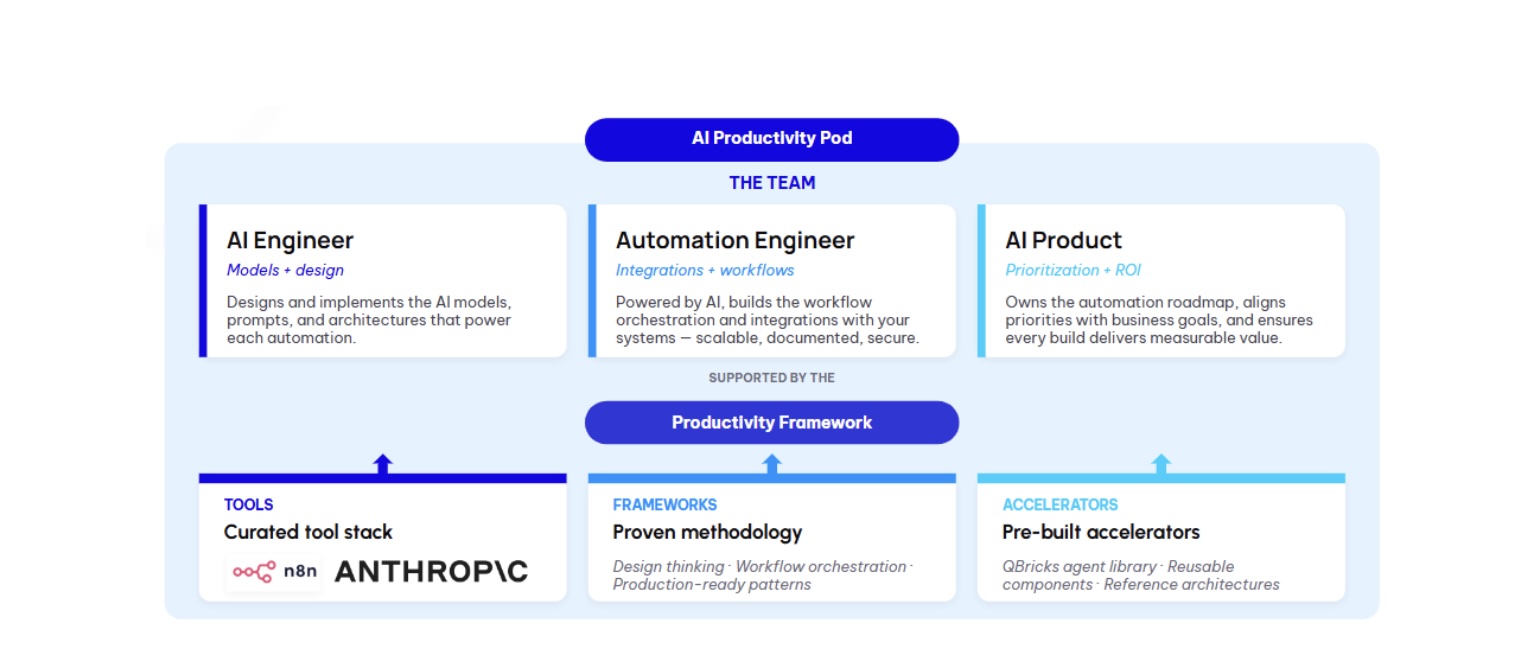
With delivery running smoothly, a new challenge surfaced: prioritization. Automation development takes time, and we needed a rigorous way to ensure that time was being invested where it would generate the most value. Consistent with how the Productivity Framework already operated, we defined a clear KPI – hours saved per year, which naturally translated into dollars – and built a scoring system to evaluate every new request the team received. Let’s now take a look at the scoring system we’re using at Qubika.
Core Metric: Annual Projected Savings (APS)
Our primary measure of value is the annual hours freed multiplied by the cost of those hours:
APS = Hours Freed per Execution × Annual Frequency × People Involved × Hourly Cost
Where:
- Hours Freed per Execution = Manual Time – Automated Time (usually automated time is ~1)
- Annual Frequency = How many times per year this process runs
- People Involved = Number of people currently doing this task
- Hourly Cost = Based on the role/team of the people involved
Scoring System Overview
Once we had a value metric, we needed a consistent way to compare requests against each other. We built a 100-point scoring system that weighs each request across four dimensions, with financial impact carrying the most weight by far:
- Annual Projected Savings — the financial impact of the hours freed, and the dominant factor in any score.
- Implementation Complexity — how much effort the build requires from the automation team.
- Strategic Impact — longer-term value, such as enabling future automations or unlocking critical capabilities.
- Urgency — how time-sensitive the request is, weighted lightly on purpose to keep us out of reactive mode.
The result is a single comparable score for every request, anchored firmly in measurable ROI while still leaving room for strategic and practical considerations.
How an Automation Request Becomes a Live Workflow
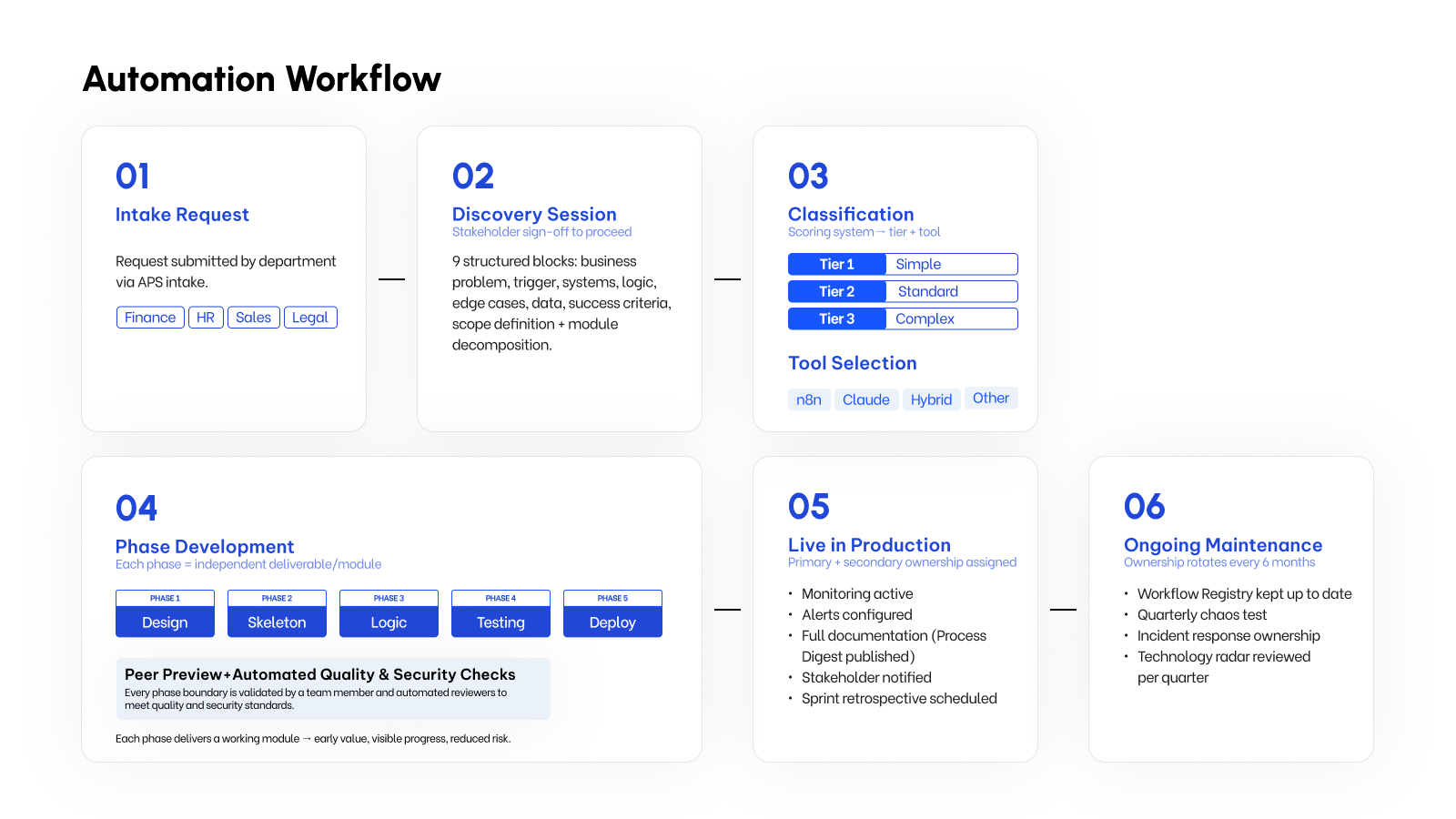
Every automation at Qubika follows a consistent six-step path designed to balance speed with rigor.
It begins when a department submits a request through the intake form, which then moves into a structured discovery session where the business problem, systems, logic, and success criteria are mapped out and scope is signed off before any building starts.
Each request is classified by complexity and matched to the right tooling, then built in independent phases – from design through deployment – with peer review and automated quality and security checks at every boundary. Once live, the workflow is monitored, documented, and handed off with clear ownership, followed by ongoing maintenance, quarterly resilience testing, and rotating ownership to keep every automation reliable over time.
System Philosophy
Every weighting in the scoring system reflects a deliberate choice about what we value most when deciding what to automate. Specifically:
- Measurable ROI (70% of the score) – Projects must demonstrate clear financial impact
- Quick wins – Low complexity projects receive strong scores relative to their APS
- Strategic enablers – Projects that unlock future value or build critical capabilities
With the system in place, we could focus our efforts on the most valuable tasks to work on towards our goal of saving the teams hours and free them to do what they do best instead of spending the time doing repetitive work.
To learn more about the Qubika Productivity Studio, contact our team.