
















A sports-tech leader raising the bar on trust and safety
FanDuel is a leading sports-tech company that has changed how fans engage with sports through betting, daily fantasy, gaming, and media. Operating across Sportsbook, Casino, Racing, and a growing payments footprint, FanDuel processes an enormous volume of financial transactions every day, each one a potential vector for fraud.
As transaction volume and product surface area grew, FanDuel’s existing approach to fraud detection — a legacy withdrawal lambda paired with manually maintained rules — could no longer keep pace. It struggled to scale, lacked feature richness, and could not combine machine-learning risk signals with business rules at transaction time.
Fragmented, rules-only fraud detection limited scale
FanDuel’s fraud processes were siloed by product and weighted toward static, manually maintained rules. This created clear constraints:
-
Fraud logic was fragmented across products rather than unified across the customer journey
-
Static rules could not incorporate ML-driven risk signals in real time
-
Every rule change required engineering involvement and a code deployment
-
Decisions could not be made fast enough to score transactions without adding customer friction
-
Data Science had no clean path to improve models continuously without engineering bottlenecks
FanDuel needed a single, data-driven platform that could deliver sub-second fraud assessments at transaction time, unify detection across every vertical, and let each team — Data Science, Fraud Ops, Engineering — move independently.
A real-time fraud platform built on Databricks
In partnership with Qubika, FanDuel built RiskPlay 360: a unified, data-driven risk platform that scores every financial transaction in real time, combining machine-learning models with configurable business rules. Databricks sits at the core of the data layer that powers it.
Streaming and batch pipelines on Databricks
-
Spark Structured Streaming jobs on Databricks consume transactional events from Kafka across Sportsbook, Casino, Racing, deposits, and withdrawals — continuously, with seconds of latency.
-
Batch PySpark jobs on Databricks compute pre-aggregated daily metrics (counts, amounts, velocity) on a scheduled cadence, pushing heavy computation “left” so that scoring reads stay fast and predictable.
-
On-demand backfill pipelines retroactively populate historical data from Databricks tables, with idempotent writes for clean gap repair and feature rollouts.
-
A governed layered data model (foundation and core layers) keeps every event, aggregate, and scoring response queryable for analytics, dashboarding, model retraining, and audit.
A low-latency feature store and scoring service
-
Streaming and batch pipelines feed an AWS MemoryDB (Redis) feature store that serves features for ~15M users at sub-100ms read latency.
-
A Risk Recommender API reads those features and runs an XGBoost model and a YAML-configured rules engine in parallel, returning an approve / review / block recommendation with a risk score and the top risk drivers.
-
Every API response is streamed back into Databricks (Delta Lake), closing the loop for Data Science to monitor drift and retrain models, and for Fraud Ops and Analytics to compare performance against business-as-usual.
This architecture lets Fraud Ops change rules through configuration — no code deployment — while Data Science improves models independently, all on top of a shared, governed Databricks data foundation.
Measurable impact
Sub-second scoring at transaction time
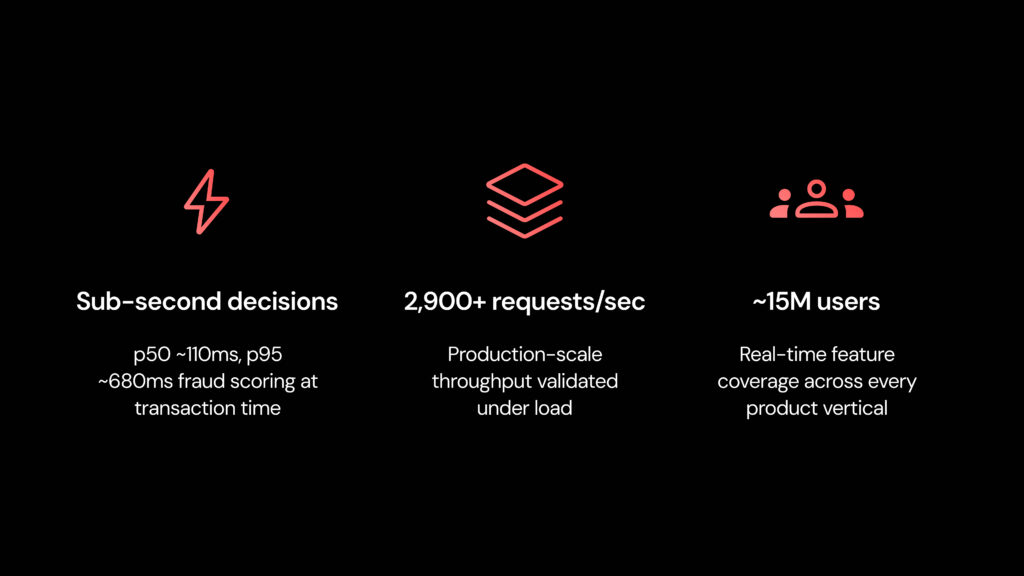
The Risk Recommender API delivers fraud decisions at p50 ~110ms and p95 ~680ms — fast enough to score transactions without adding customer friction.
Production-scale throughput
Load testing validated 2,900+ requests per second, giving FanDuel headroom for peak events.
Unified coverage across verticals
Ten continuous streaming pipelines and three daily batch-aggregate jobs feed real-time features for ~15M users across Sportsbook, Casino, Racing, deposits, and withdrawals.
A more efficient feature store
Moving from raw-timeline scans to pre-aggregated daily summaries cut MemoryDB utilization from ~70% to ~45%, making scoring latency bounded and predictable while lowering cost.
Team independence
A YAML-driven rules engine lets Fraud Ops adjust logic without deployments, and a Delta Lake feedback loop lets Data Science retrain models without engineering bottlenecks.
From dark-live to full production
RiskPlay 360 went to dark-live in January 2026, reached 100% of withdrawal traffic in March 2026, and moved into enforced, action-based decisioning shortly after — with deposits fraud detection next on the roadmap.
A foundation for trust and safety at scale
By building RiskPlay 360 on Databricks, FanDuel replaced fragmented, rules-only fraud detection with a single real-time platform that scores every transaction in milliseconds and combines machine learning with configurable business rules. The streaming-plus-batch Databricks foundation gives Data Science, Fraud Ops, and Engineering a shared, governed, and observable base to build on — and a clear path to extend fraud detection across the rest of the customer journey.