









Every year, Gartner’s Magic Quadrant generates plenty of discussion across the technology industry. Vendors celebrate their positions, customers compare platforms, and analysts debate market direction.
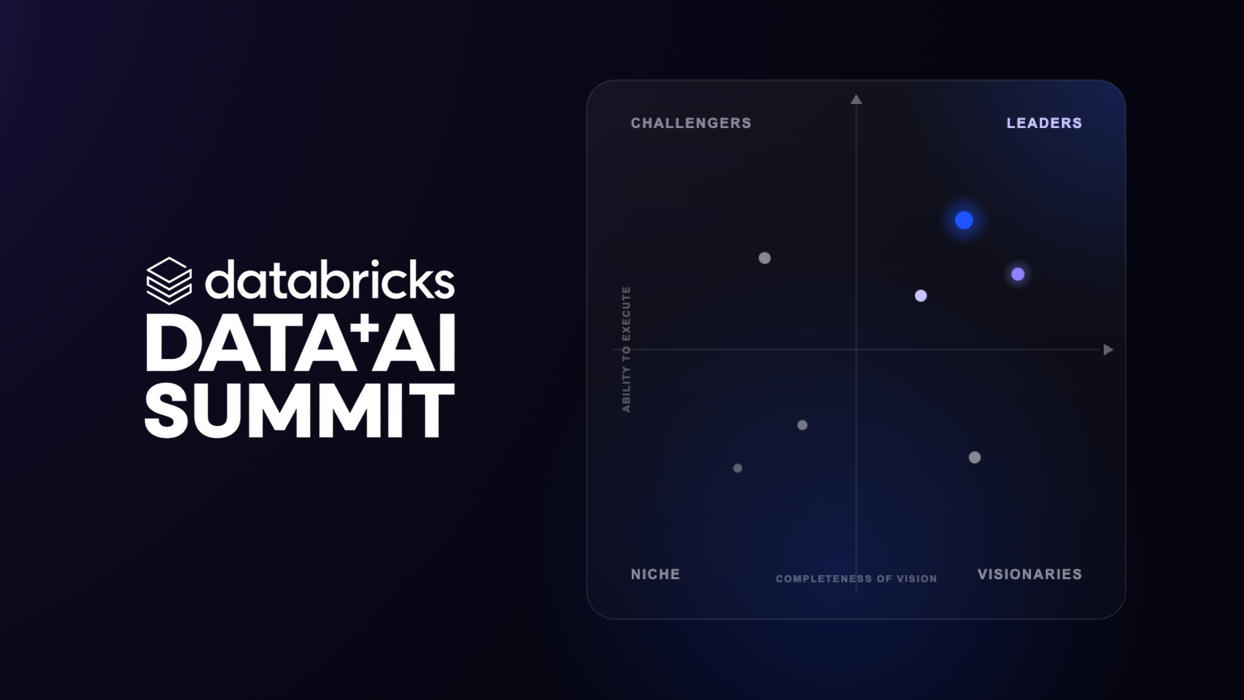
This year, Databricks was positioned highest for Ability to Execute and furthest for Completeness of Vision in Gartner’s 2026 Magic Quadrant for AI Platforms for Data Science and Machine Learning, marking the second consecutive year in that position.
Achieving such a recognition is no small feat. We also think it’s reflective of something bigger – it demonstrates how the needs of enterprises with respect to AI have changed so quickly and dramatically over the past couple of years. In this article I’ll examine what this means in more detail.
AI Platforms Are No Longer Just About Machine Learning
Only a few years ago, organizations evaluated platforms primarily based on their ability to build, train, and deploy machine learning models.
Today, that evaluation looks very different.
Modern enterprise AI platforms are expected to provide:
-
Unified data management
-
Governance and security
-
AI agent development
-
Model lifecycle management
-
Retrieval-Augmented Generation (RAG)
-
AgentOps and observability
-
Support for multimodal AI applications
Gartner’s report reflects this shift throughout its evaluation criteria, emphasizing AI agents, governance, context management, and enterprise-scale operational capabilities rather than traditional ML alone.
In other words, the conversation has moved beyond “Which model should we use?”
The more important question has become:
How do we operationalize AI across the enterprise using trusted, governed data?
Data + AI Summit 2026 Reinforced the Same Vision
The announcements made during Databricks Data + AI Summit closely mirrored the direction highlighted in Gartner’s report.
Rather than introducing standalone AI features, Databricks continued expanding its vision of a unified enterprise AI platform where data, governance, analytics, databases, and intelligent agents work together.
Some of the most significant announcements included:
-
Agent Bricks, accelerating the development and deployment of enterprise AI agents.
-
Lakebase, introducing a fully managed PostgreSQL database for AI-native operational workloads.
-
AI Gateway, providing centralized governance, security, observability, and control for enterprise AI applications and model access.
-
The expansion of the Genie product family, including innovations such as Genie One, Genie Agent, Genie Ontology, and ZeroOps, bringing conversational analytics, semantic understanding, and autonomous AI experiences to both business and technical users.
-
Continued investment in Unity Catalog as the governance layer connecting data, models, AI assets, and agents.
Taken together, these announcements reveal a broader strategic direction.
Databricks it’s evolving into a comprehensive enterprise AI platform where governed data, transactional systems, analytics, and intelligent agents operate within a single architecture.
Enterprise AI Is Becoming a Data Problem
One of the strongest themes throughout the Summit was surprisingly simple: The competitive advantage isn’t the model. It’s the data.
Foundation models are rapidly becoming commodities. Enterprise knowledge isn’t.
Organizations already possess unique business processes, proprietary datasets, customer interactions, operational history, and domain expertise. Unlocking that information safely is becoming the primary challenge for enterprise AI initiatives.
This explains why governance technologies like Unity Catalog have become increasingly strategic.
Without trusted data, secure access controls, lineage, and observability, AI agents cannot reliably operate in production.
The focus is shifting from model experimentation toward enterprise execution.
The Business Numbers Tell an Equally Important Story
Technology announcements are important.
Business execution matters even more.
During the Summit, Databricks shared several milestones that illustrate the scale at which enterprise AI adoption is occurring:
-
Over $4 billion Annual Revenue Run Rate
-
More than $1 billion Annual Revenue Run Rate from AI products
-
More than 650 customers generating over $1 million in Annual Recurring Revenue (ARR)
-
Continued growth above 50% year-over-year
These aren’t simply indicators of a successful software company.
They demonstrate that enterprise organizations are making long-term strategic investments in unified data and AI platforms.
That context also helps explain Gartner’s assessment of Databricks’ execution capabilities.
The report highlights several strengths, including the company’s rapid pace of innovation, unified governance strategy for AI agents, organizational growth, and a large global technical community supporting the platform.
Gartner’s Bigger Message
Perhaps the most interesting part of the report isn’t the quadrant itself.
It’s Gartner’s strategic assumptions for the next few years.
Among its projections:
-
By 2027, organizations will deploy significantly more task-specific AI models than general-purpose LLMs.
-
By 2028, at least 15% of day-to-day business decisions will be made autonomously through agentic AI.
If those predictions prove accurate, organizations won’t simply need better AI models.
They’ll need platforms capable of managing thousands of AI-powered workflows, governed data assets, autonomous agents, and enterprise-wide operational controls.
That’s a very different challenge from building a chatbot.
Our Perspective
At Qubika, we’re seeing this evolution firsthand across industries.
Organizations are moving beyond isolated GenAI proofs of concept and asking more strategic questions:
-
How do we govern enterprise AI?
-
How do we connect AI to trusted business data?
-
How do we operationalize AI safely at scale?
-
How do we build systems that remain maintainable over time?
Those questions are no longer about selecting the “best” model.
They’re about building the right platform.
The 2026 Gartner Magic Quadrant is an interesting snapshot of today’s market.
But more importantly, it signals where enterprise AI is heading next.
And that future appears to be less about individual models and far more about the platforms that connect data, governance, applications, and AI into a single enterprise ecosystem.
Further Reading
Gartner
-
Gartner® Magic Quadrant™ for AI Platforms for Data Science and Machine Learning (2026)
Gartner, Yogesh Bhatt, Afraz Jaffri, et al., June 22, 2026.
Databricks
-
Databricks Positioned Highest in Ability to Execute and Furthest in Completeness of Vision in the 2026 Gartner® Magic Quadrant™ for AI Platforms for Data Science and Machine Learning
Databricks positioned highest in execution and furthest in vision for the second consecutive year in Gartner Magic Quadrant | Databricks Blog -
Data + AI Summit 2026 Keynote
Databricks Data + AI Summit 2026 | Leading AI Conference -
Databricks Surpasses $4B Revenue Run Rate, Exceeding $1B AI Revenue
Databricks Surpasses $4B Revenue Run-Rate, Exceeding $1B AI Revenue Run-Rate – Databricks
Qubika
Check out some of our perspectives on the recent Databricks Data + AI Summit 2026.
- Everything Databricks Announced at the DAIS Data + AI Summit 2026
- Databricks App Spaces and Genie App Builder: Building Enterprise Apps
- OpenSharing and Genie Agents
Product Announcements
-
Agent Bricks
-
AI Gateway
-
Lakebase
-
Unity Catalog
-
Genie (Genie One, Genie Agent, Genie Ontology, ZeroOps)